
Every major town and city has a drag where the businesses that do not and cannot make the astronomical rents in the centre of town ply their trade. They are often populated by businesses built by people who have come to the UK to seek a better life and to build something for their adopted community.
Often they are oases, sometimes enclaves, but wherever they are, they survive by their guile and popularity alone.
Oxford Road is Reading's version of this. You do not have to look up the latest census that tells you that 43% of our fellow Dings are from an 'ethnic' background (not sure if we Celts count in there, I presume not). All you have to do to tell where they come from is to tot up the shops along the road and divide by Nepal, Afghanistan, Pakistan, Poland, Romania, Nigeria, Brazil and Ghana.
And there is a corner of Oxford Road that is a bit Africa, with four African restaurants, three of which are within view of each other, as well as a couple of specialist markets.
So, a brisk stride down our global esplanade, past the recently revitalised Reading West station (very smart), past the mosque and the old Battle Hospital and just opposite the giant Tesco, you come to Betty's Bistro - until recently Reading's only Ghanaian restaurant, (but recently joined by another very similar eatery just up the road).
'Let's order an African ' may be one of the less common demands made of an evening in British homes, but with a growing population from the continent, and more understanding of the varied menu items, perhaps this will change. Perhaps jollof rice will become the next biryani.
My companion G was game for something new - his only trip to West Africa was his honeymoon to Gambia some time ago now given that his son is soon to marry.
I have a long association with West African food, running from a long term relationship at university through a Ghanaian business partner when I was in the music industry, and then a keen interest in cooking dishes from the region. So I was eager to introduce him to its delights - and quirks.
Most cuisines around the world are based on a staple made out of starch - rice, pasta, potato, yams, bread. It takes many forms - biryani, noodle soup, polenta, roast potatoes, grits and toast to name but a very few. Udon and papardelle and mashed potatoes and vermicelli and sourdough to name a fee more.
For Europe and Asia, and to some degree North America, these are all familiar to us. If we were doing a skills challenge on MasterChef most of us could not only name them, but probably know how to cook them.
But we live in a wide world and there are many other flavours and textures of starch that may yet to be discovered. If you head south of the equator, particularly, things become somewhat less familiar.
In the areas of the world where the population is growing fastest, basic nutrition based on these startches is essential, and here less familiar staples become commonplace.
Cassava, yam and maize are the 'daily bread'. Which is why African food can seem unfamiliar.
All of this is by way of an introduction to the menu at Betty's Bistro. It is actually a takeaway with some seating for at most sixteen to eat in, as is the way with so many eating places in the home delivery era we live in.
We arrived at around two (it opens at 13:30) and there was a steady flow of customers, some eating in, some taking away. Almost all seemed to be African.
Ordering at the counter, the service was friendly. We asked if we could bring in some drinks which G went and got from the Tesco over the road, since Betty's is unlicensed and we have traditions to uphold.
Wanting to try as much as possible, we inevitably over-ordered. Some specials are only available on a Sunday (and it is closed on a Saturday). You can specify your protein, with goat as default.
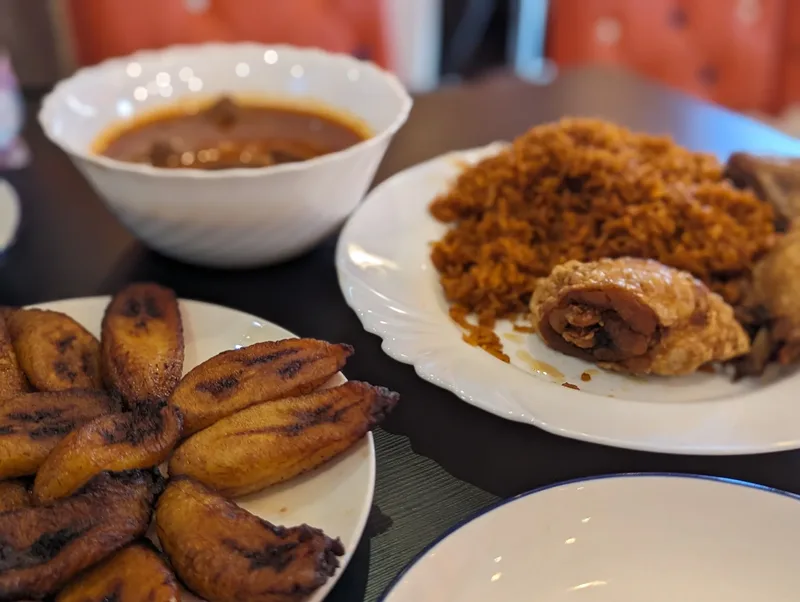
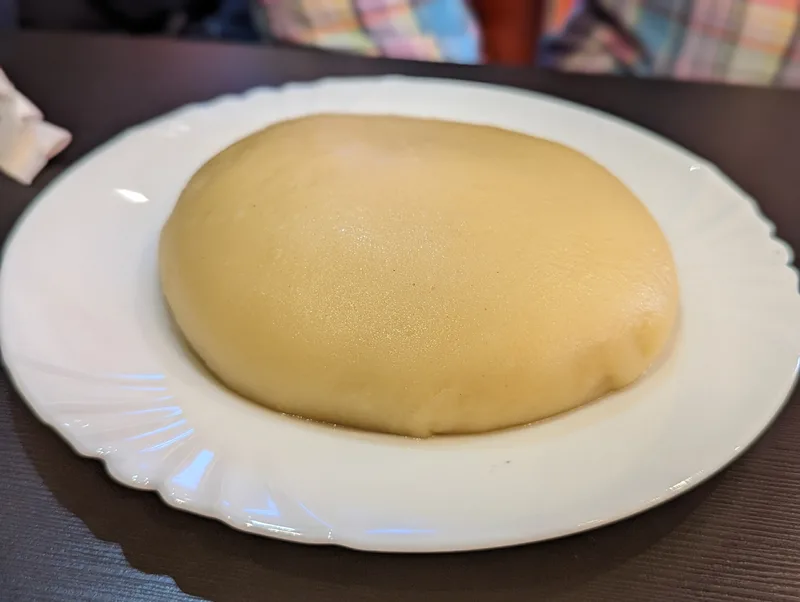
Okra stew came with goat and banku - a starch served in clingfilm made from maize and cassava that is lightly fermented. The most familiar way of describing its taste is knocked back bread mixture before it is baked, but this does not do it justice.
Usually you would tear and dip the staple into the stew and consume. We used cutlery.
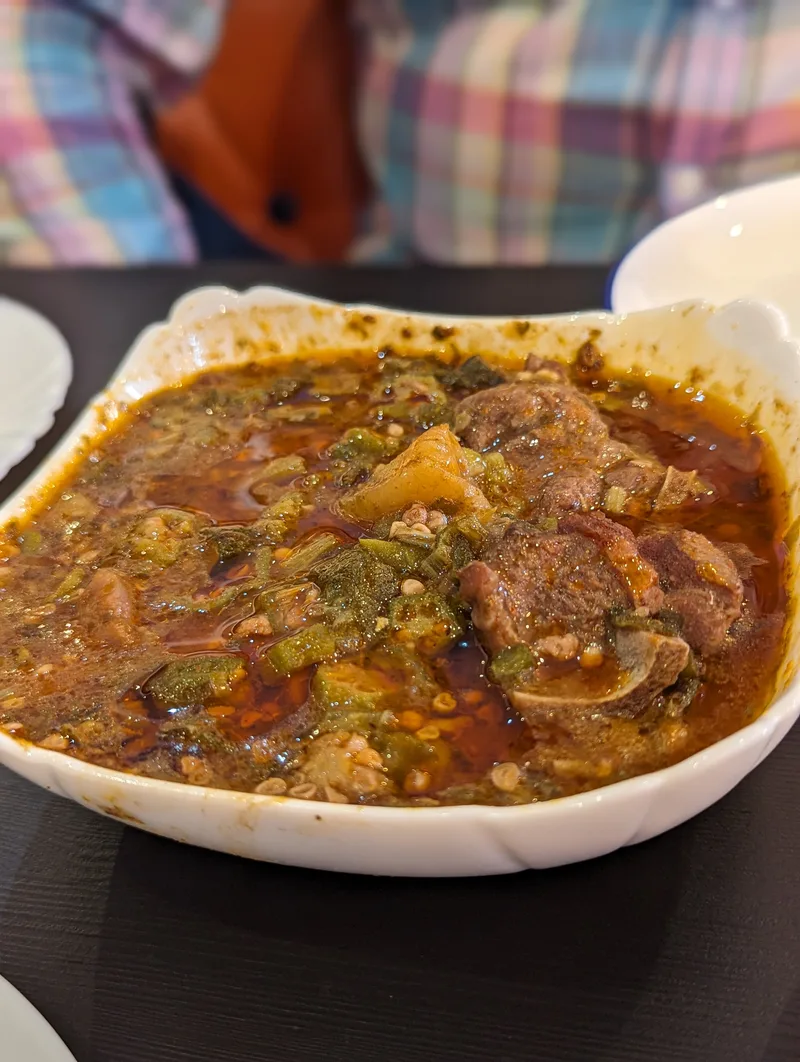
Okra, with its stringy spittle consistency, is something of a particular taste, as is goat, in this case rack meat cooked on the bone until tender. It was utterly delicious. West African cuisine does not use very complex spice mixes like the ones found in North Africa. The most common flavourings, as here, are dried fish powder (used a bit like fish sauce or shrimp paste in Asian cooking), ginger, white and black pepper and bouillon. Tomato, thyme and paprika are often used, with the flowery heat of scotch bonnet peppers a dominant taste. Anyone familiar with Caribbean food will recognise the palate.
The goat soup was suitably warmed with scotch bonnet peppers in a tomato sauce. Very bearably hot. The foufou was lovely. There are various ways of producing foufou, but I would guess in this case that the cassava had been ground to a paste with some plantain giving it additional taste. As with mashed potatoes, the texture of foufou is everything, and this was smooth and silky.
A side dish of fried plantain (it entertained the server that I used the Nigerian term 'dodo' to describe them) were, in my taste, under salted and a bit mushy, although the perfect ripeness made them sweet and still somewhat irresistable. Good fried plantain in my view should be cut, salted and left to dry and then fried in very hot oil so that there is some crunch on the edges.
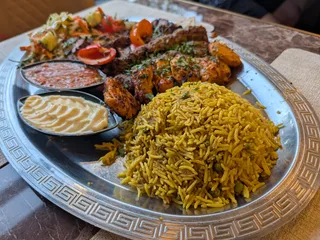
Finally, of course, there was jollof rice, served with some fried chicken.
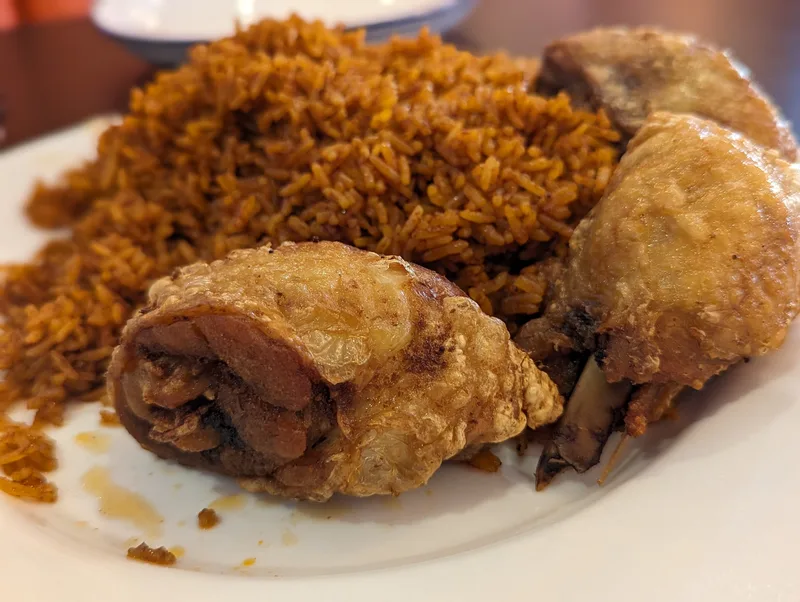
Anywhere in this part of Africa, jollof rice is the metric, like Butter Chicken is in India or roast potatoes is to a Sunday Lunch in the UK.
It is usually made by creating a sauce of onions, chillies, red peppers, thyme and paprika and then adding rice and water. There are a million varieties and lives have been lost and marriages made on the back of this dish, believe me.
This version was a bit disappointing to my taste - not tomatoey enough, with too much mace or allspice and a bit overly greasy and dry.
Sorry, Betty, I know this is the worst thing I could possibly write about any West African restaurant, and it may just be that the Nigerians and Senagalese have pulled the rice over my eyes. That said, G loved it and most of the enormous dish disappeared along with the accompanying fried meat (by defult it comes with turkey).
This is sustenance food, comfort food, aimed firmly at those familiar with the cuisine, but it deserves a wider audience.
Dishes come in small, medium and large and the smaller versions are ample and wonderful value for money. We had a mix. Our total bill was an incredibly reasonable £33, which barely gets you a burger in a pub with a pint these days. Over the road is the somewhat upmarket Nigerian 805 restaurant where a single dish will cost you more than this, albeit with sides. But we can leave that for another day and another review.
Betty's is not catering (nor compromising) for the likes of me. It is a Ghanaian restaurant for West Africans, so the rest of us can just get on board and enjoy this as an occasional alternative to the rice, noodle and potatoes based cuisines we know so well. Give it a go !
Comments
No comments yet. Be the first to share your thoughts.
Join the conversation
Log in to leave a comment on inReading.