
In my younger days I had a thing for everything Japanese. I think it came from doing judo and then karate and then doing my major in Japanese film.
My interest extended to Japanese food and I learnt how to cook basic dishes whilst still at uni.
Back then, before the days of even YoSushi!, the first Japanese restaurants I went to were in Paris. One even had food on a conveyor belt, long before they appeared in the UK and became YoSushi!'s main gimmick.
There were a handful of ultra expensive Japanese restaurants around Bond St and then there was the Japan Centre in Brewer St, which is were I ate my first sushi and tempura. Those where the days when the Swiss Centre promoted Switzerland not M&Ms and many countries sought to excert a cultural influence in London. Part of the problem was that Japan was so successful and the UK was in such dire straits that they felt obliged to do some foodie PR. Perhaps we Brits missed a trick, with English breakfasts on the Costa del Sol being our international outreach effort. Ho hum.
The thing about Japanese food is that it is very diverse and very specialist. In Japan, it's not unusual to find restaurants that specialise in one dish, let alone one style of cooking (or so I understand, since I have still not managed to visit - I hear that it's actually quite a cost effective holiday these days and they could do with our British pounds, being by now the most indebted developed country on earth).
There's ramen and udon and ramen and all the noodle soups, there's tepyaki and teryaki and yakatori. There's tempura, and, of course, sushi, but also kaiseki for formaldining and izakaya for Japanese pub food.
Reading has lots of sushi joints. Both Waitrose and M&S have dedicated sushi counters. But almost all are takeaways, and some do specialise.
The brand new Sume on Broad St does Japanese noodles as does Marugame Udon down by Oracle Riverside; IroSushi and YouMe Sushi have small shopfronts on Friar St., Kokoro and Itsu are just round the corner. Out of Oxford Road there's Oishi.
Sushimania has always had a good reputation but is likely to shortly fall victim to the redevelopment of Broad St Mall but remains on the must visit list. Up in Lower Earley there's Blissful Umami, which I think has a sister restaurant in Wokingham, which itself has by now a choice of sushi joints.
Intoku and Osaka are two reasonably independent Japanese restaurants in the town centre, both offer a slightly more diverse range of dishes than the norm.
So, for a town with hardly any European restaurants and only one gastropub in the centre, there are choices, choices and choices of Japanese food, So it was high time the inReading food blog went Japanese.
After a long tour of the northern and western coasts of his native Scotland, G was back in town and it was time for a catch up.
On my last visit to Osaka my wife and I had taken her god daughter and sister who live in Singapore. Their mum runs a VC in Japan and they eat sushi weekly and compared Osaka favourably with the places they were used to in the Far East. Which is high praise indeed, and after a run of really bad experiences I wanted to write a positive review.
The biggest bugbear I have about sushi is how predictable it is. Salmon, salmon, salmon and a bit of tuna, the odd prawn and maybe some mackerel (which sadly we shouldn't be eating at present).
But Osaka presents a reassuringly delicious range of fishy options including octopus, prawns, eels, crab and, yes, tuna and salmon.
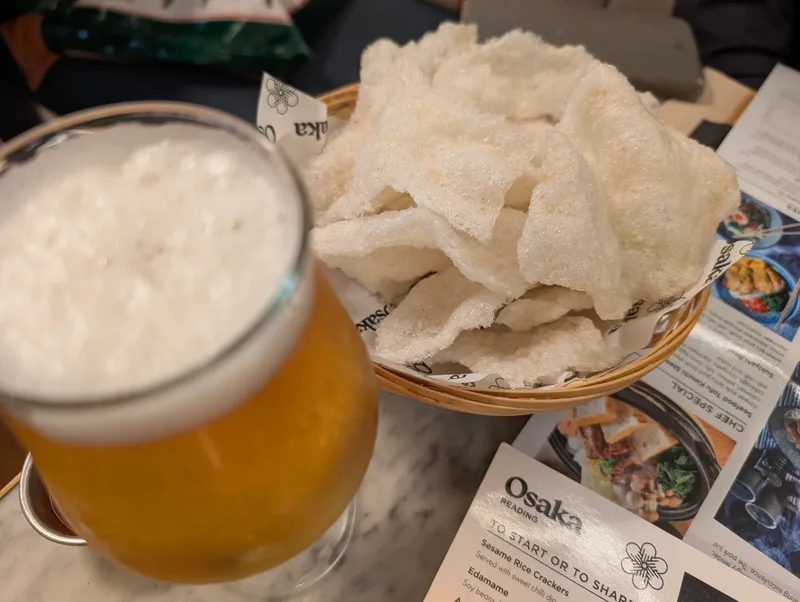
I arrived to find G sipping a beer and eating crackers with dipping sauce. I ordered the Kirin Ichiban (number one) Japanese beer and nibbled on the crackers, which I found a tad tasteless and a bit soggy, and I am a fan of prawn crackers, so I would give these a miss unless you really are ravenous and need something whilst waiting. G accurately called them 'Japanese Rivita' and they were by some distance the worst part of the meal.
.
Two beers and a proper catchup later over his journeys to Scotland and my journey of a lifetime to Egypt, we were ready to order.
On a Thursday lunchtime it was moderately busy and around half full in the downstairs part. (These things are important to report in these bedevilled days).
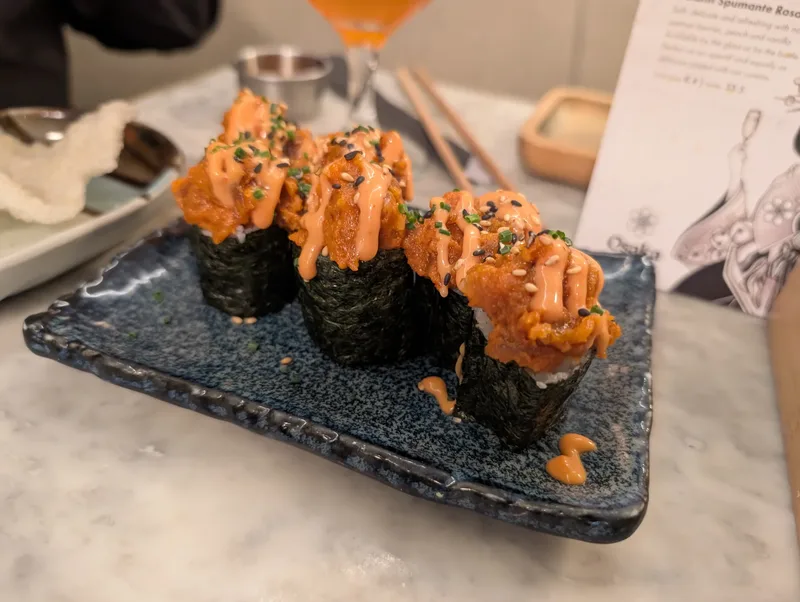
We ordered spicy tuna maki, which came with the fish and sauce on top of the seaweed and rice roll. It was just the right side of hot warm in the mouth, but tuna is a very subtle fish and, on reflection,with sushi this good, less may be better and the ordinary tuna makimight have been a better call. Next time.
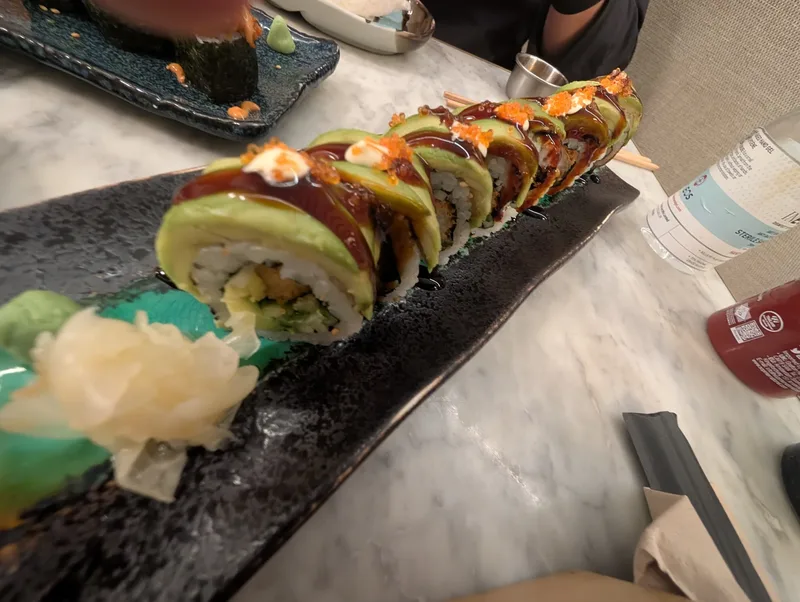
Green dragon uramaki with generous 'Western' fillings of cucumber (for crunch, I guess) and avocado (for smootheness) along with the deep fried prawn in batter.
At this point it'sworth talking rice. Sushi rice is slightly sticky and glutious and cut with a very little vinegar. Whereas in an Indian or Chinese restaurant there is great room for inaccuracy, the mainstay of sushi has to be the quality of the rice. It needs to be chewy but soft with a very slight acidic taste. I notice when the rice changes - I had a very bad lot from Waitrose lately, where the rice was ever so slightly undercooked, but this meant that nothing worked (my wife works from home on a Friday and sushi from Waitrose in caversham is our fish Friday - she is a lapsed Catholic, after all..). Osaka's rice is exemplary.
Likewise Tempura is a measure of any Japanese kitchen. We ordered the selection which generously included prawn, courgette, beans and carrot with a teryaki like dipping sauce. Personally, I like some chilli mayo with my tempura. And that is the beauty of Japanese food - for a country that eats KFC quasi-religiously on Christmas Day as an aftermath from US occupation, anything quirky goes.
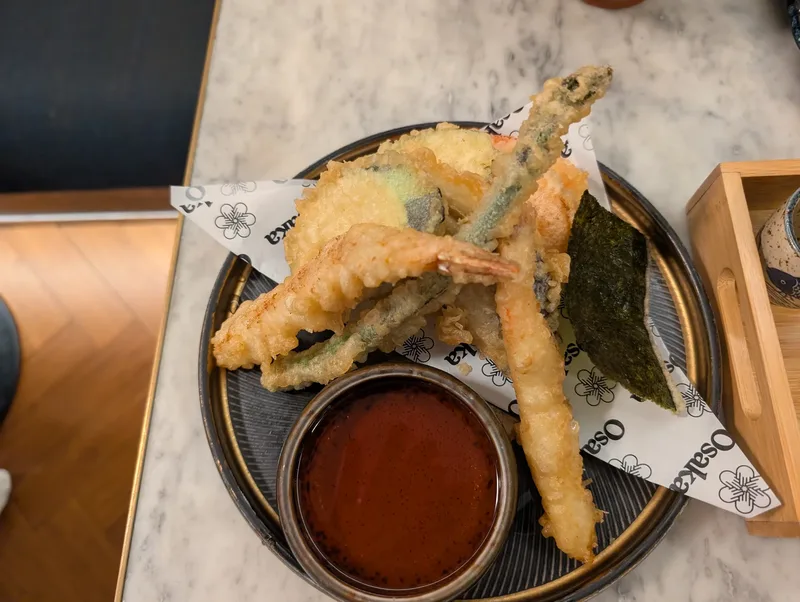
Tempura is also not easy to get right and this batter was as good as I have tasted, with carrot tempura being a revelation - a hard vegetable surprisingly lends itself well to being battered and deep fried, and was the very unusual highlight of this meal, among many other high notes. I pointed out that this could be a revelation to the good people of Glasgow, but G ignored me...
Finally G enthusiastically insisted that we had takoyaki balls. They are basically profiteroles with strong fishy creamy filling of pureed octopus topped with mayo, bonita (tuna) and nori (seaweed) flakes. I had never tried them before and probably will not again, despite eating two of them, which came atop a bowl of crispy salad. I'm not sure what it was, but when profiteroles are one of your favourite things in life (I used to live around the corner from the immortal original Popelini in Paris).
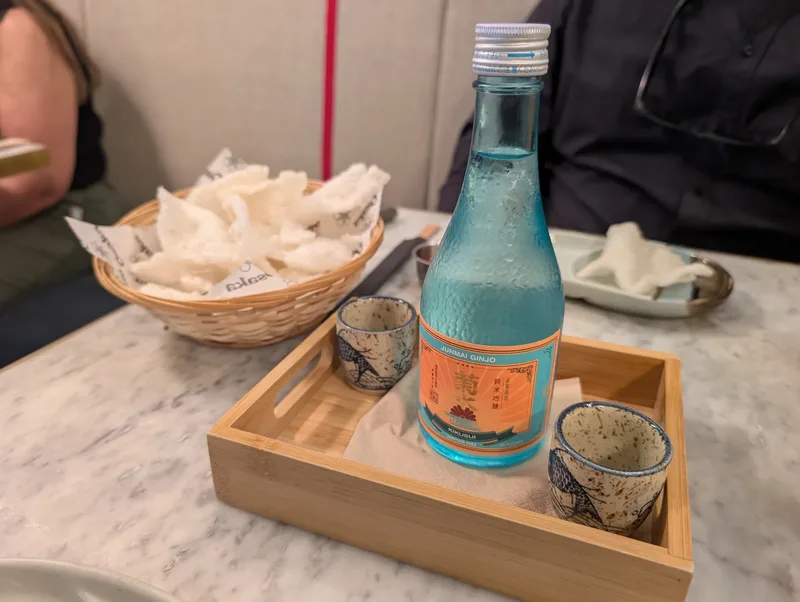
And of course, some delicious, smooth Junmai Gingo saki which with its slightly fruity taste went extremely well with the meal. I am no sake expert but had this one before in New York and it is to be recommended. At the equivalent of £30 a full bottle for an similar wine it is also very good value.
The portions at Osaka are more than generous at sensible prices and our idea of continuing with noodles will now have to wait for another day.
It's not hard to see why Osaka is thriving and the group is looking to open another branch at Station Hill (although that is now long delayed and you wonder if it is a sensible move in these straitened times). One Osaka may very well be enough for Reading, along with all those other Japanese takeaways.
Sushi Roundup
Some of the types of sushi that you will encounter in your journeys around Reading's Japanese restaurants and takeaways are:
Nigiri - a small mound of rice topped with a slice of fish or other ingredient such as Sake (salmon), Maguro (tuna), Ebi (shrimp), Unagi (grilled eel) ir Tamago (sweet egg)
Maki - rolled rice and fillings rolled in seaweed (nori) wrap and sliced into bite sized pieces such as Hosomaki (thin rolls, 1 filling), Futomaki (thick rolls, multiple fillings), Kappa maki (cucumber) and Tekka maki (tuna).
Uramaki - 'inside out rolls' with rice on the outside, seaweed inside - rather more popular outside Japan with variations such as California roll (crab, avocado, cucumber), Dragon roll (eel, avocado), Rainbow roll (topped with mixed fish) and Spider roll (soft-shell crab). Can come with hot sauce or crunchy onion toppings. They're often more elaborate and “Westernised.”
Sashimi - slices of raw fish without rice so technically not sushi. Salmon, tuna, yellowtail, octopus, etc. Just pure fish—no rice, no distractions but with prices to match.
Temaki - cone-shaped rolls meant to be eaten by hand, filled with rice, fish or veg.
Oshizushi - pressed sushi made in a mould, then cut into blocks. Common in Osaka (the place)-style sushi it tends to be firm, neat, and slightly different texture.
Chirashi - is a bowl of sushi rice topped with assorted fish and ingredients - sort of “deconstructed sushi.”
Inari Sushi - rice stuffed inside sweet fried tofu pockets that are mild, slightly sweet - a good vegetarian option.

Comments
No comments yet. Be the first to share your thoughts.
Join the conversation
Log in to leave a comment on inReading.