
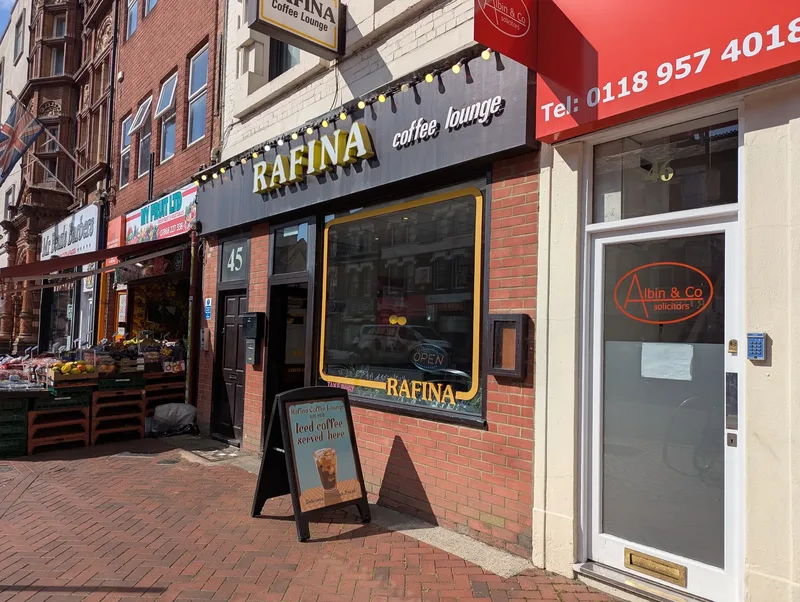
I had to take the car in for a service at the crack of dawn, so caught the number 6 back into town and found myself in St Mary Butts early in the morning and feeling peckish. As most of you will know, there are enough eating places thereabouts to choose from ranging from the teeth breaking sourdough sarnies at Paul to a sneaky breakfast Taco Bell. But I fancied a 'proper breakfast'.
And there was one place that has long been on my radar. In retail terms, Rafina looks like it has stood where is stands for at least fifty years without changing at all. I'm sure that there are local grandparents who will fondly remember the decoish frontage from their childhood. Heck, there are probably great grandparents who feel nostalgic about this place. So, with the sad demise of Munchees on my side of town, this seemed to be an excellent opportunity to try out this old timer.
After all, 'greasy spoons' were the making of eating out in Britain. Not for us the brasserie or trattoria, especially in those poor threadbare years after the war with rationing and scarcity.
No, fancy restaurants were not the British way. But the influence of many Italian emigrees, many of them left behind prisoners of war, changed British cuisine for every. (as an aside I recently saw David Olusanga speak in Oxford and he mentioned that the one TV series he wanted to make was about the history of Britain in immigration and food – he could base the entire series in Reading - he's speaking at the Town Hall in early October).
In every seaside town and inland city there was an Italian ice cream parlour and coffee shop. In Wales, where I grew up, every town large enough to have a bus service had an Italian coffee shop or ice cream parlour. I can still taste the hand churned vanilla ice cream from Bertorelli’s on the square in Caernarfon, served by a dour faced Italian man with a massive grey moustache, a brown work coat and a very dour demeanour. It was the best taste ever.
These caffs became a place of social gathering, especially for teenagers who could not get into pubs, and formed the bedrock for the introduction of the rich tapestry of ethnic cuisine that we benefit from today in Britain.
But they did not get too exotic in an era when pasta came only in tins.
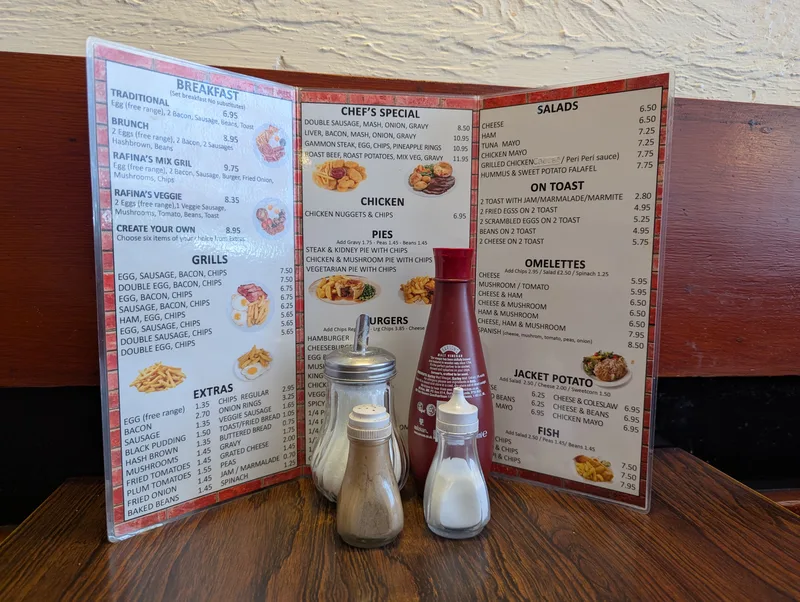
With plastic seats, Formica tables with metal legs and flock carpet that looked like it came from a long closed pub, it reminded me of the cafe in my home town where we would go after school and on rainy Saturday afternoons with friends and girlfriends, sipping frothy milk with Nescafé and sugar that remains a more prevalent taste of my teenage years than even cheap cider does.
On a day that was rapidly warming up, I ordered an iced coffee, which was milky and very sweet (they didn't ask if I wanted it adding) but nice and strong. I do like an iced coffee because it’s difficult to make a bad one (as long as you avoid the mango frappuccino rubbish found in certain coffee chains, of course).
The Traditional Breakfast arrived promptly, and here we must tread carefully into a minefield, because for a dish that is pretty standard from John O Groats to Land's End and from Norfolk to the Dingle peninsula, breakfast is up there with Sunday Lunch as the meal that is traditional and a standard for British cooking but whose ingredients create fervent debate.
Of course, the British (or Irish) breakfast has subtle parochial variations - I have had haggis in Scotland, cockles and laver bread in Wales and white pudding in Northern Ireland, but it is the core ingredients that cause the most controversy.
After all, a ‘Full English’ is what you really rate your hotel or B&B on - the pillows might be plump, the receptionist friendly, but a bad breakfast (or just a continental breakfast!) and they are, er.., toast. And, go on, admit it, you’re away from home and the yoghurt and croissant won’t cut the mustard. It has to be the Full English (or Welsh, or Scottish or Irish..).
So, what are the de rigeur ingredients in your fried meal ? Well, bacon, eggs and sausages, of course. But mushrooms, tomato, black pudding and beans ? And what about hash browns (never chips) and toast. (whilst white or brown sliced bread becomes hand crafted sourdough from a thirty year old starter yeast at posher establishments).
It is stuff that long running disputes are made of. Enemies are made, marriages are broken. (“What ? You put beans on the plate ? I’m divorcing you..!”). For my wife it has to be very runny eggs. And if there are beans they have to be on the side, and for a Frenchwoman, I never understood her dislike of black pudding (or boudin noir). But she loves mushrooms, as long as they're not tinned. Lots of mushrooms, which I can happy leave off.
I feel the same about canned plum tomatoes - I like a good cooked plump round tomato half grilled until brown with my sausage. And for me, beans is the sauce in all of this - the toast (or sourdough) is simply there to mop up the melded juices of the beans and the egg, unctuous, runny and fatty sweet.
This is, perhaps, why those breakfast buffets are a good idea, until you come to the eggs, which have been eviscerated by those heat lights used in hotels the world over.
To give credit to Rafina, they provide several varieties of breakfast and you can easily pick and mix whatever you want on your plate (but no black pudding, although spinach is a rather bizare possibility).
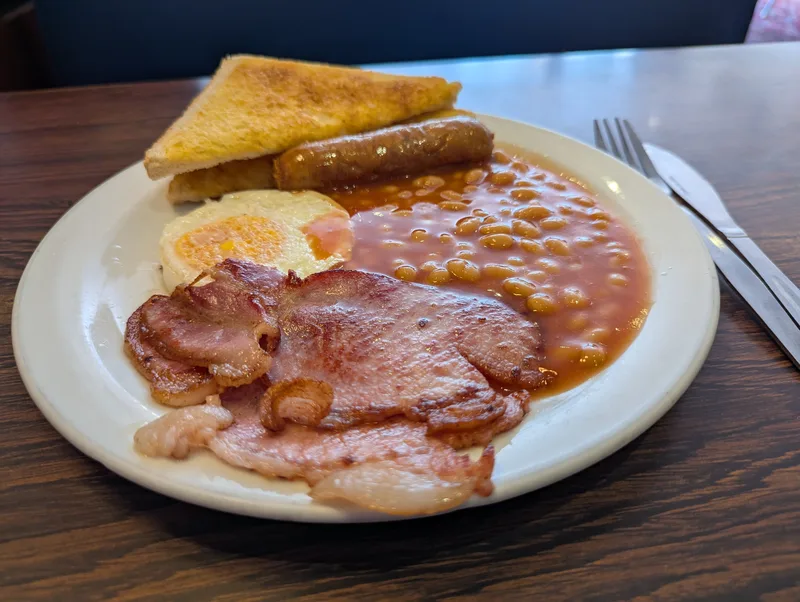
The Traditional comes with two rashers of nice thick and not over salty bacon, an overcooked egg that is ring fried so you don't get the spread - mine was overcooked with a hard yolk, like one of those sad components of a breakfast McMuffin. Points deducted aplenty.
The sausage was one of those cheap and cheerful ones where you can taste the meat and the filler but whose skin was nice and thin (latest pet peeve of mine - sausage skins that sit like stale unchewable condoms in your mouth). It came slathered in beans (yum!) with two already buttered slices of soggy white toast on the side.
It was far from perfect, but totally hit the spot. As more and more chains come to Reading, it was nice to turn back the clock and experience where we have come from. And it’s very a long way but even in these days of huevos rancheros and shashlik, I suspect that the fried breakfast has a long way to go yet in the story of British food.
Comments
No comments yet. Be the first to share your thoughts.
Join the conversation
Log in to leave a comment on inReading.