
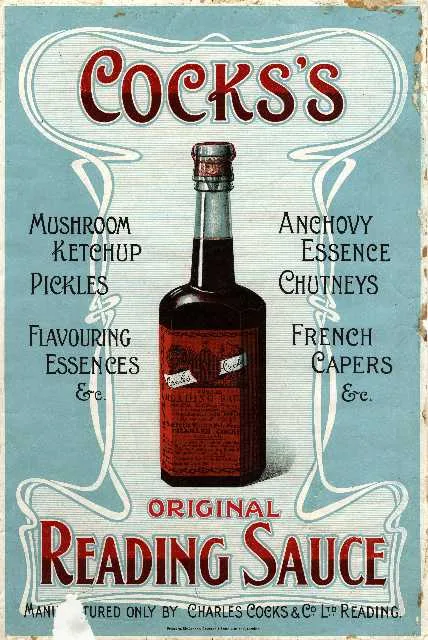
Reading Cock's Sauce was a traditional English condiment with a long history rooted in our town. It was once a staple in British households and a popular export.
The Sauce traces its origins to the 19th century, during the Victorian era. It was originally invented by James Cocks, who opened a fishmongers shop on Butcher's Row in 1789 (now part of Broad Street and King Street).
The sauce gained popularity as a competitor to Worcestershire sauce, offering a spicier and tangier alternative.
The Sauce is even mentioned in the book Around the World in Eighty Days by Jules Verne.
The "Cock's" part of the name is believed to refer to the rooster, a traditional symbol of morning or awakening, possibly alluding to its strong and awakening flavors. The sauce became widely recognized and was exported across the British Empire during its peak.
After James died his son Charles took over the business, opening a larger factory on the King's Road in the 1830s, now the site of Reading Central Library. But, despite its initial success, the production of Reading Cock's Sauce eventually declined in the last century.
The exact recipe for Reading Cock's Sauce has historically been a closely guarded secret, much like Worcestershire sauce. However, it is known to contain a blend of ingredients that give it a tangy and umami-rich flavor.
The main ingredients of the original sauce were walnut ketchup, mushroom ketchup, salt, anchovies, chillies, bruised ginger, spices (cloves, allspice and black pepper would have been likely), salt and garlic. Vinegar and molasses were probably also used.
Once mixed and cooked it was left to stand in barrels for three to five years!
Homemade versions of the sauce have been attempted by culinary enthusiasts based on descriptions of its flavor profile, though the precise proportions remain a mystery.
Reading Cock's Sauce was traditionally used as both a table condiment and a cooking ingredient. Its robust flavor made it a versatile addition to various dishes as an ingredient to add tang, as a marinade or as a condiment for flavouring.
The sauce could also be used as a dipping sauce or mixed into sauces and dressings, making it a staple for enhancing meals.
During its heyday, Reading Cock's Sauce was widely distributed across the UK and exported to various parts of the British Empire in distinctive bottles with an orange label. The distinctive bottles have become collectible items for history enthusiasts. The sauce's popularity waned in the mid-20th century as consumer preferences shifted and competition increased.
Today, Reading Cock's Sauce is no longer produced commercially on any scale.




Comments
No comments yet. Be the first to share your thoughts.
Join the conversation
Log in to leave a comment on inReading.