
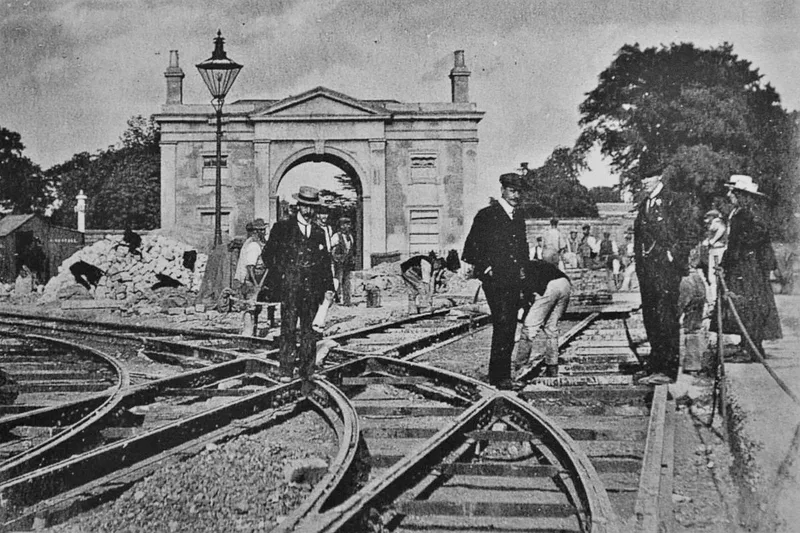
If you’ve ever sat in a queue of traffic on London Road, watching the red brake lights stretch down Kings Road and Wokingham Road, you know that you live in Reading and you know that you are at Cemetery Junction, a junction famous enough to have a film named after it.
It is the undisputed eastern gateway into Reading and also acts as a funnel from the motorways and dual carriageways to the east of town, creating a throttle point for all traffic recently exacerbated by the addition of bus lanes.
Standing like a lost sandstone sentinel right at the heart of this bustle is the Grade II listed Cemetery Arch. Thousands of us pass by it every day by car, on a bus, by foot, scooter or bike. It’s a striking reminder that this was once a peaceful, rural corner. Or to quote a joke by a friend of mine, 'the dead centre of Reading'. Cheers,John.
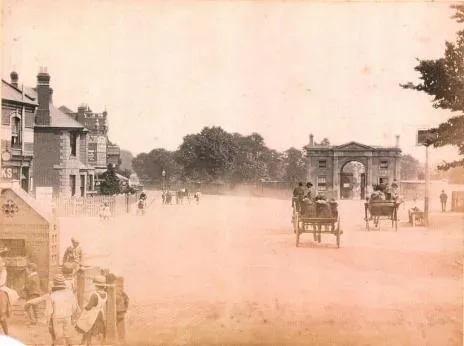
In the early 1840s, Reading was booming. The arrival of the Great Western Railway in 1840 had supercharged the town's population, and local churchyards were rapidly running out of space.
In response, a group of local businessmen formed the Reading Cemetery Company in 1842. They bought a parcel of rural land well outside the town's then compact boundary, but conveniently nestled between the historic highways leading out of the town to London and Wokingham, an area thought to have already previously been used as an interment ground for the dead from the Abbey's leper hospital, with bones discovered by workmen in a burial pit.
Architect William Brown was tasked with designing a landscape that followed the fashionable Victorian trend of 'garden cemeteries'—places not just for mourning, but for the living to walk among beautiful trees and classical architecture. The walled cemetery and the Cemetery Archway were completed in 1843.
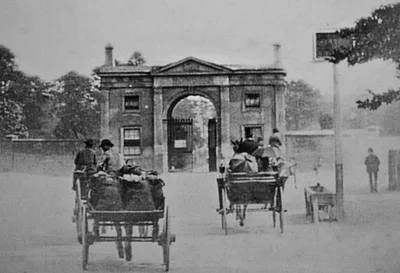
Built in the grand Neolithic Grecian style from Bath stone, it served a dual purpose: a magnificent formal entrance for funeral processions and a practical lodge for the cemetery registrar. When the cemetery officially opened space for burials in 1843, it transformed what had been a simple fork in the road into a landmark.
The graveyard itself contains the last resting place of many famous local citizens including the Sutton seeds and Simmonds brewing families, including the grave of the sculptor of the Maiwand Lion statue in Forbury Gardens, George Simonds. Some of the gravestones themselves are listed.
Urbanisation
As the 19th century progressed, Reading expanded eastward at a breakneck pace. The open fields surrounding the cemetery were quickly swallowed up by the grid of streets in Newtown, built to house the workforce for Huntley & Palmers biscuit factory, and the grander Victorian villas of London Road and Redlands.
The junction where London Road, Wokingham Road, and Kings Road converged inevitably became a commercial and transit nucleus with shops appearing to service the local and transient population.
The Trams Arrive
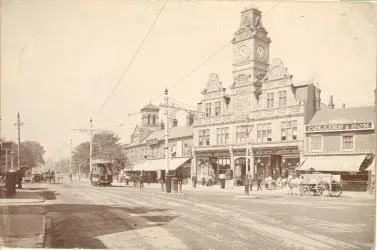
In 1879, horse-drawn trams began clattering past the Cemetery Arch. By 1903, these were replaced by Reading Corporation’s sleek electric tram system.
The Junction became a crucial tramways intersection, and a bustling interchange for passengers heading out to Earley or Wokingham or into the town centre.
By the time motor cars and trolleybuses replaced the trams in the mid-20th century, the "Cemetery Junction" moniker was firmly locked into the local lexicon—even if most people passing it by nowawere thinking about their morning commute rather than the graveyard.
Pubs and Shops
To serve the growing local population and weary travellers alike, the local shops and pubs inevitably expanded.
The first pub on the site was built in the early 1800s and appearing on the 1841 Census as a beerhouse operated by Joseph Pickett. Now called the Hope & Bear, it was formerly known as the Abbott Cook, Upin Arms and Jack Of Two Faces - an appropriate name for a building on both London and Kings Roads.
Adjacent is the former Cemetery Tavern, renamed the Marquis of Granby (John Manners, Marquess of Granby (1721–1770), was a brilliant and immensely popular British army commander during the Seven Years' War who gave sptpiends to his injured soldier that they could use to open taverns). It was once owned by football legend Terry Venables and is now, of course, a burger and ice cream parlour.
And just off the junction is the ever popular late night drinking dive Up The Junction. Pharmacies, takeaways, convenience store and mini markets sit alongside longterm tenants such as tghe every fascinating Reading Stained Glass and the latest sandwich bar from Cafe Yolk.
The arch itself was used as a police outpost for many years.
Pop Culture and the Modern Era
In recent decades, Cemetery Junction has earned a spot in broader British cultural history. It famously gave its name to the 2010 retro-comedy-drama film 'Cemetery Junction', written and directed by Reading’s own Ricky Gervais and Stephen Merchant. While the movie itself was filmed elsewhere and did not feature the junction at all. to capture a 1970s small-town vibe, Gervais frequently cited the real-world location as a symbol of being on the crossroads of life, deciding which direction to take. Perhaps something that regular commuters ponder on as they are stuck at the lights.
Today, the Junction faces the classic challenges of a modern urban bottleneck. After years of sitting empty, the iconic Archway itself has been the subject of passionate community campaigns aimed at preserving it and transforming it into a vibrant community arts hub. It is currently undergoing restoration.
While the council officially started planned, 12-week conservation and masonry cleaning works in February 2025, thecontractors, Cliveden Conservation, and structural engineers quickly hit a major snag. While putting up scaffolding and getting a closer look at the upper masonry, they uncovered significant, acute defects to the front stone gable and a leaning pediment thanks to traffic polution ands water damage.
The council's ultimate goal is to complete the core stabilization so that the building can be safely brought back into active community use. They have been working in tandem with the local community group Junction Arch Heritage and Arts (JAHA).
JAHA has been working to secure National Lottery Heritage funding to transform the arch into a permanent community heritage and arts hub, featuring space for local art exhibitions, one-off community events, and a small café—carrying on the vision originally championed by late local coordinator Nick Cooksey.
Not many towns and cities are know for their junctions and especially one named after a cemetery, but that's Reading for you..!

Comments
No comments yet. Be the first to share your thoughts.
Join the conversation
Log in to leave a comment on inReading.