

As the May 2026 local elections approach, the silhouette of cranes across the Reading skyline tells a story of two towns. One is a thriving technology and logistics hub, buoyed by its proximity to London and the Elizabeth Line with PepsiCo moving its HQ into the town centre and pharma giant Sanofi taking up residence in Thames Valley Park; the other is a community grappling with an increasingly untenable housing crisis where a homeless person fell seriously ill in a tent on Broad Street and died shortly afterwards in hospital.
It's not surprising then that for many residents the primary metric of the town’s success is not its GDP, but the length of the housing register and the visibility of those without their own front door - and this may spell electoral problems for the majority Labour party that has long controlled the town, come the forthcoming elections.
Social housing, which became viewed as a right for many Brits after the Second World War until its provision was dismantled by Margaret Thatcher, is currently at the center of a political and economic storm in Reading.
To many, asylum seekers and illegal immigrants are seen as a reason for the lack of public housing - a position being milked by the far right - who ironically have no plans at all to build any more social housing. But asylum seekers actually have no right to social housing. The problem isn't immigrants, it's the far right policies implemented by Thatcher and perpetuated by Blair and then thirteen years of subsequent Conservative rule. And it looks like our current Labour regime isn't going to make any difference as they run scared from the far right.
With ever rising rents, thousands of households in limbo, and the Council facing unprecedented financial strain, the reality is that Reading needs around a substantial programme of social house building.
The Labour ruling party on Reading Borough Council is being slated for only completing 11 council homes during 2025, and due to 'right to buy', our town probably lost social homes. And their disasterous dismantling of Housing for Reading, which threw another 400 people onto the housing market was a further debacle.
Rob White, leader of the Greens was highly critical:
"I am deeply worried about affordable housing in Reading. New figures show that Reading Borough Council missed its own target by a huge margin. Last year, only 11 affordable homes were delivered, when the target was 169. That is not a small slip. It is a serious failure."
Labour leader Liz Terry responded by pointing to more recent developments:
"I was lucky to be at the Wensley Road estate in Coley last week to celebrate the official opening of 46 new homes. It is a particularly special project because all households moving in to them are from Reading’s Wensley Road community.
"We’ve created two 4-bed houses, 26 3-bed houses, two 1-bed and two 2-bed wheelchair accessible ground floor flats, six 1-bed flats and eight 2-bed flats. Many are already occupied with the remainder allocated and soon to be filled. They form part of a wider estate improvement project, which has seen a new play park opened, new landscaping including additional pathways, and new parking spaces and roads."
But the actual scale of the challenge is best understood through the Council’s housing register. As of early 2026, the registered list of those waiting for a social home was over 3,000 households, possibly representing as many as 10,000 people. Despite the Council’s efforts to prioritize those in the most urgent need, the reality is that less than 10% of those on the register are housed in any given year.
This bottleneck has direct consequences for homelessness. Reading’s rough sleeping rates have historically been among the highest in the South East. In 2025, official counts estimated approximately 46 people sleeping rough per 100,000 - this may sound low, but it is a rate significantly higher than the regional average. From View Island, to Kenavon Drive and the Thames towpath, you will find people living in tents and boats that should be condemned.
But the homeless woman in her fifties who recently died was living in a tent in a Broad Street bus shelter in Reading, opposite HSBC. Most Reading residents probably walked past her 'home' without a thought.
And beyond the visible rough sleeping and waiting lists for social housing, a hidden and massively expensive homelessness crisis is temporary accommodation.
The Temporary Accommodation Crisis
According to the latest data from the Ministry of Housing, Communities and Local Government (MHCLG) approximately 387 to 400 households were living in temporary accommodation in Reading in mid-2025.
This represents a nearly 20% increase compared to the same period in 2024, with the number of families with children in temporary accommodation rose significantly, with a 33% increase (an additional 75 households) recorded between 2024 and 2025. (It should be noted that asylum seekers are totally outside this model. They may be housed in the borough but are paid for by the Home Office and have no rights to council accommodation.)
A complicating factor in Reading's data is the use of the town by other councils for their homeless population. For example, in 2024/25, Oxford City Council placed 34 of its own homeless households in temporary accommodation within Reading because they ran out of space in Oxford. These people are living in Reading, but they are technically counted in Oxford's homelessness statistics, not Reading's, and are paid for by Reading, although all liabilities apart from housing fall locally.
Supply vs. Right to Buy
To be fair, Reading Borough Council has not been totally idle. Under its current Council Plan (2025–2028), the administration has committed to delivering over 300 new council homes. But the count of eleven new homes in the past financial year is a scandal that has spured them into some action with the opening of those 46 new homes on the Wensley Road estate and the acquisition of properties on Dwyer Road.
However, a "leaky bucket" effect persists thanks to right to buy and restrictions on further building by councils. For every new home built, others are lost through the Right to Buy (RTB) scheme. Recent data indicated that between 2021 and 2023, the total stock of council homes in Reading actually decreased slightly, despite the council's building program.
As of early 2026, Reading Borough Council manages approximately 5,800 to 5,900 homes. To put this in perspective, in 1979, roughly 30% of Reading's housing stock was council-owned. By 2025, that figure has dropped to approximately 15%.
So why does the council simply not build more houses when it can afford to buy office buildings as an investment - Reading Borough Council purchased Kennet Wharf on Queen's Road, the European home of Visa, for £20.1 million in February 2018 as part of a commercial investment strategy, for example.
Well, In the post-war decades, building council houses wasn't just a policy; it was a national mission. Today, while the spirit might be willing, the financial and legislative machinery is far less amenable.
The biggest shift since was the 1980 Housing Act. It introduced "Right to Buy," which has seen over 1.5 million council homes sold into private hands.For decades, councils were forced to sell homes at massive discounts and were legally blocked from keeping all the proceeds to build new ones. Most of that money went back to the Treasury to pay down national debt. Thank you, Margaret.
While the government recently allowed councils to keep 100% of receipts and reduced the discounts, the "yo-yo" effect remains. Councils are currently spending millions buying back the same houses they were forced to sell decades ago—often at 5-6 times the original price.
In the 50s and 60s, the government essentially wrote a blank cheque for housing. Today, councils operate under the Housing Revenue Account (HRA), a ring-fenced "business" that must balance its own books. Even though the "debt cap" was removed in 2018, councils are still limited by what they can afford to pay back. High interest rates in 2025–2026 mean that borrowing from the Public Works Loan Board (PWLB) is expensive.
To keep social housing affordable, the government often caps how much rent councils can charge (currently pegged agains the Consumer Price Index). This is great for tenants, but it limits the "profit" councils need to reinvest in new bricks and mortar.
In the past councils had massive powers to buy land cheaply through Compulsory Purchase Orders (CPOs), but today they have to compete with commercial developer. Until very recently, if a council wanted to buy a field for housing, they had to pay the "hope value"—what the land might be worth if it had luxury flats on it. This made land prohibitively expensive. In Reading land is very expensive and swathes of the town, such as the area to the west of Katesgrove and Kennet Island being restricted from development by age old nuclear safety regulations.
We are only just seeing the impact of the 2024–2025 reforms that allow councils to ignore "hope value" for social housing. However, legal battles with landowners are still slowing this down.
In the 1960s, you could "throw up" a tower block with minimal insulation or safety tech. Today, councils face a mountain of regulatory costs and restrictions - even commercial developmetns have ground to a halt thanks to the consequences of legislation introduced to prevent another Grenfell Tower disaster. The requirement for a second staircase in high rise blocks and the introduction of the Building Safety Regulator (BSR), which has become a massive bottleneck in areas like London, resulting in almost all commercial property development grinding to a halt in the capital.
Councils are legally required to fix damp, mould, and safety issues in existing stock within strict timelines and new homes must now be nearly zero-carbon. This adds roughly 15–20% to the cost of every single house compared to just a few years ago.
Finally, and perhaps most ironically, the UK has a massive skills shortage in the building sector after Brexit.
The Rise Of Housing Associations
While the Borough Council is the most visible provider of low-cost housing, it does not act alone. Housing Associations -officially known as Private Registered Providers (PRPs) - form the "third pillar" of Reading’s housing canopy. Currently, these non-profit organizations manage a portfolio in Reading that nearly matches the Council’s own stock, with over 5,500 units across the borough.
The landscape in Reading is a patchwork of large-scale regional providers and specialist local groups. A2Dominion and Housing Solutions are among the largest, managing significant estates and modern apartment blocks. Meanwhile, organizations like Launchpad Reading provide supported housing specifically for those transitioning out of homelessness.
A major point of contention UK wide is the distinction between "Social" and "Affordable" rent levels. Social Rent, typically charged by the Council and some older association tenancies, this is set at approximately 50% of local market rates whilst affordable rent is the model adopted by most housing associations where rents can be set at up to 80% of the market rate.
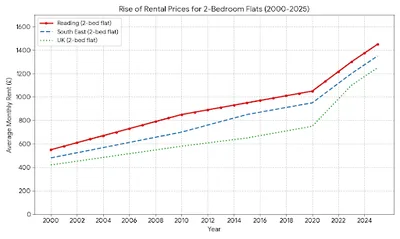
In a high-demand town like Reading, where private rents have surged, even an "affordable" 80% rate can put significant pressure on low-income families who do not qualify for full housing benefits.
Despite being separate entities, the Council and Associations operate a unified system. To ensure fairness, Reading uses a 'Common Housing Register'. When a Housing Association property in the town becomes vacant, the Council usually holds "nomination rights" for 75% to 100% of those lets. This means that regardless of who owns the brick and mortar, the Council’s waiting list remains the single point of entry for those in need.
And housing associations are not exempt from the political debates surrounding the "leaky bucket" of social stock. While Council tenants have the Right to Buy, most Housing Association tenants have a similar, though slightly different 'Right to Acquire'.
Section 106 agreements place a legal requirements on private developers—such as those building the high-rise apartments near Reading Station—to provide a percentage of homes to housing associations. These quotas are often negotiated down by developers, or replaced with financial contributions elsewhere.
While the Council remains the single largest landlord, several Housing Associations manage thousands of properties across Reading.
Housing associations have merged and now often operate across multiple local authorities, but their presence in Reading is significant enough to shape entire neighborhoods like Coley, Whitley, and Tilehurst. Here are the largest in out town:
A2Dominion ~1,500+ properties . One of the largest regional providers. Significant presence in central Reading and managed "Retirement Living" schemes like Cornerstones in Tilehurst.
Southern Housing ~1,200+ properties. Formed from the merger of Optivo and Southern Housing Group. They manage a mix of social rent and shared ownership across the South East, with a major hub in Theale/Reading including Livonia View between the river and railway line in east Reading.
Housing Solutions ~800+ properties. Focuses heavily on the Berkshire area. They manage diverse stock across Reading, including key worker and family housing.
Stonewater ~600+ properties. A major national provider with a strong local footprint, particularly in retirement living (e.g., Raglan Court) and general needs housing.
Abri ~400+ properties. Formerly Radian/Yarlington. They are increasingly active in new-build "affordable" developments on brownfield sites around the town
Affinity Housing ~350+ properties. Often works in direct partnership with the Council on specific PFI (Private Finance Initiative) contracts, particularly in North Whitley.
The sheer volume of Association-owned property means that the housing issues faced by Reading cannot be solved by the Council alone. The Council has nomination rights to the vast majority of these housing association properties' vacancies, so this directly impacts how fast the 3,000-person waiting list moves.
Recent governments have spent a lot of legislative time regulating private landlords, but a key political issue now is social landlord accountability. Service charges have been increasing well above the rate of inflation and there is an increasing call for stricter local oversight of housing associations, following resident complaints regarding costs, repair delays and the handling of serious issues such as damp and mold in older blocks.
This said, smaller associations like Launchpad Reading and Abbeyfield are essential for supported housing in our town Without them, the Council would face even higher costs in providing specialized care for the elderly or those recovering from homelessness.
The Economic Impact: A Council on the Edge
The housing crisis is not just a social issue; it is a fiscal one. Reading Borough Council has had to find nearly £13 million in savings and efficiencies over the last three years, largely driven by the rising cost of essential services.
The economic "knock-on" is clear: when residents spend 40% or more of their income on rent, local spending in Reading’s retail and hospitality sectors suffers. Furthermore, the high cost of housing makes it difficult for essential workers—nurses, teachers, and bus drivers—to live within the borough, leading to recruitment crises in public services.
Political Choices
With homeless people dying on our high street, the far right fearmongering and the cost or renting continuing to rise, the three main parties in Reading are offering distinct visions for the future of social housing.
The Labour Administration
Labour highlights its track record of building the first new council houses in a generation. Their platform focuses on "fairer communities," arguing that despite national headwinds and RTB, they are the only party with a proven delivery model. They are lobbying the national government for a complete overhaul of RTB rules to allow councils to retain 100% of receipts for rebuilding.
The Green Party
Having seen significant gains in recent years, the Greens argue that the current pace of building is insufficient. They point to the net loss of social stock as evidence of a failed strategy. Their 2026 manifesto calls for a "moratorium on council house sales" and a more aggressive use of Compulsory Purchase Orders (CPOs) on empty long-term properties and derelict offices.
The Liberal Democrats and Conservatives
The Liberal Democrats have focused heavily on the private rental market, calling for better protections for tenants to prevent them from needing social housing in the first place.
The Conservatives, meanwhile, emphasize the role of the private sector and housing associations, arguing that the Council should focus on "enabling" rather than being the primary builder, while supporting the aspiration of homeownership through shared equity schemes.
A Difficult Future
Reading is a town of immense potential, but that potential is being throttled by a housing market that no longer serves a large portion of its population. The social housing crisis is the thread that connects homelessness, council insolvency, and economic stagnation. Having homeless people die on our streets cannot make anyone feel good about their town.


Comments
No comments yet. Be the first to share your thoughts.
Join the conversation
Log in to leave a comment on inReading.