
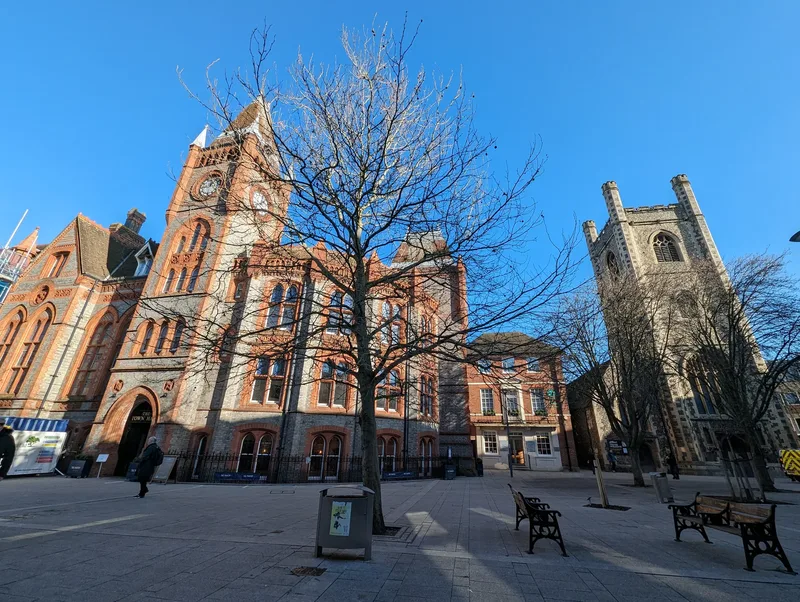
As the latest local elections loom, we take a look at how Reading has been governed down the years, from the shadow of a medieval abbey to the meeting rooms of our revamped twenty-first-century civic offices.
There is a moment, repeated across the long bureaucratic history of Reading, that captures something essential about the relationship between our town and the idea of self-government. It comes in different guises down the centuries — as a monastic dispute, a parliamentary charter, a cholera outbreak, an election night count — but its substance is always the same: Reading its right to decide its own affairs.
As most readers will know, Reading today is the largest town in England without city status, a distinction it wears with a mixture of civic pride and mild grievance. Sitting at the confluence of the Thames and the Kennet, roughly equidistant between London and Bristol, its geography that has made it commercially important since the early medieval period and politically contested for just as long.
The current population of roughly 183,000 is served by an unitary authority — Reading Borough Council — that has been under Labour majority control since 2012 and is headquartered in the recently revamped Civic Offices on Bridge Street. Although large parts of the town’s suburbs are split out into other boroughs – Wokingham and West Berkshire.
To understand how Reading Borough Council came to have its present form, you have to go back considerably further than 2012. All the way to the foundation of Reading Abbey.
The Abbey and the Borough: Governance Before Democracy
Reading was described as a borough in the Domesday Book of 1086, which places its civic identity among the oldest in England. William the Conqueror had given land in and around the town to his foundation at Battle Abbey in Sussex, and the presence of six mills — four on royal land, two on Battle Abbey's — suggests a settlement of some commercial complexity. But the decisive event in Reading's medieval governance came in 1121, when Henry I founded Reading Abbey as a Cluniac Benedictine monastery, and with it granted the abbey lordship over the entire town.
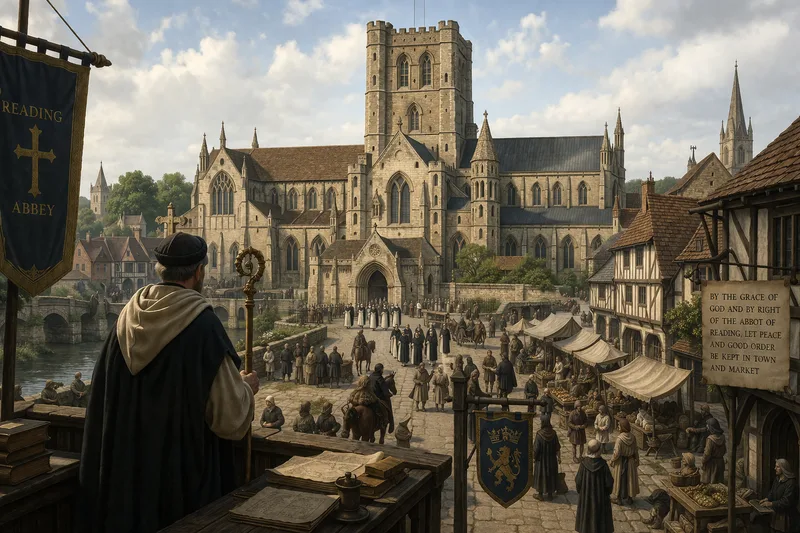
This was not merely a spiritual arrangement. The abbey's control was comprehensive: abbots regulated commerce, relocated markets to the Forbury area near the abbey precinct, and hosted annual fairs that drew merchants from across Berkshire and beyond. The offices of reeve and bailiff — the town's earliest administrative roles — were appointments of the abbot, not of the townspeople. A document from the reign of Henry II records the names of Warin the Reeve and Walter the Reeve as witnesses to a grant by one of the abbots; they were, almost certainly, officials serving at the pleasure of the monastery. For well over a century after its foundation, Reading was, in all practical terms, governed by an ecclesiastical corporation.
The town began to assert itself gradually from the thirteenth century onwards. At the beginning of Henry III's reign, Reading appears to have been in danger of losing its burghal status altogether, so complete was the abbot's dominion. The struggle that followed — between the commercial interests of the town's merchant class and the institutional authority of the abbey — is poorly documented but unmistakable in its outlines. Royal charters, including one from Henry III in 1253 that confirmed burgess rights to regulate markets, collect tolls, and administer local justice, gave the townspeople an incremental legal foothold against the abbey's dominance, but the tension was never fully resolved before the more drastic resolution came in the sixteenth century.
Henry VIII's dissolution of Reading Abbey in 1538 was, among its many consequences, a convulsive moment in the town's governance. The last abbot, Hugh Faringdon — also known as Hugh Cook — refused to surrender peacefully. He was charged with high treason for allegedly concealing participants in the Pilgrimage of Grace and denying the King's supremacy over the Church. He was attainted without formal trial and executed in November 1539 in the Forbury, the open ground before the abbey gates, becoming one of only three abbots to die in this way during the dissolution. With the abbey gone, the institutional framework that had governed Reading for four centuries was simply abolished, and for a brief period the town was administered by the King's officers managing the dismemberment of the abbey's properties.
The solution came in 1542, when Henry VIII granted the town's Guild a new charter that permitted the burgesses to elect their own mayor — a fundamental shift. For the first time in its history, Reading had a genuinely elected civic head, albeit elected from the ‘middle class’ members of the town’s guilds.
Then, Elizabeth I's charter of 1560 set out the borough's boundaries with some precision, encompassing the whole of the parish of St Laurence and parts of the parishes of St Giles and St Mary. Those boundaries, remarkably, would not be substantially altered until 1887. The body that governed within them was formally known as the mayor, aldermen, and burgesses of the borough of Reading — a formulation that would persist, with modifications, for nearly three hundred years.
The Civil War and the Cost of Geography
Reading's misfortune in the seventeenth century was topographical. Sitting precisely halfway between Royalist Oxford and Parliamentarian London, on the main road connecting both, it was the kind of place that every army needed to control and no army wanted to inhabit. The consequences for the town's population — roughly five thousand people at the time — were severe.
King Charles I entered Reading in November 1642, following his inconclusive engagement at Edgehill, and left behind a garrison of some two thousand soldiers under the command of Sir Arthur Aston, a veteran of the Thirty Years' War who combined military competence with an apparently limitless talent for making enemies of the people he was supposed to protect. The town was required to house the garrison, fund its fortifications, and cover Aston's salary — which was so disproportionate that he reportedly loaned money back to the town at interest. Stuart Hylton's 2017 history of the town names Aston as one of the most unpopular figures in Reading's recorded past, and contemporary accounts make it easy to understand why. So, before complaining about our current local politicians, take a beat !
The Parliamentarian response came in April 1643. The Earl of Essex marched an army of over nineteen thousand men from Windsor — sixteen thousand infantry, three thousand cavalry, plus artillery — and arrived before Reading on the fourteenth. He feinted as though bound for Oxford, then swung his forces around to the south and west of the town, where the defensive earthworks were weakest, and seized Caversham Bridge, cutting Reading off from Royalist relief. By the sixteenth, the artillery was positioned and the bombardment began. On the nineteenth, an extraordinary thing happened: Aston was struck by debris dislodged by cannon fire and rendered, apparently, literally speechless. Command passed to his deputy, Colonel Richard Feilding.
On the morning of the twenty-fifth of April, Feilding displayed a white flag and sought terms. That same afternoon, a relief force commanded by Charles I himself and Prince Rupert attacked the Parliamentarian positions at Caversham Bridge. Feilding's officers urged him to break the truce and join the battle. He refused, saying that he would not do so "if the king himself should come and knock at the gate, and command him to do it" — a statement of personal honour that effectively ended his military career. The Royalists were repulsed. The surrender terms were agreed on the twenty-sixth of April, and the garrison marched out the following day with flying colours and four pieces of ordnance, bound for Oxford. Feilding, for his probity, was court-martialled within days of reaching the city, convicted of treason, and sentenced to death. Charles I eventually pardoned him but stripped him of his rank.
Aston, meanwhile, discovered that he had recovered his voice during the march to Oxford. The war's toll on Reading was severe in ways that outlasted the fighting itself. The town changed hands repeatedly — Parliamentary forces occupied it from April 1643, lost it to a Royalist incursion that September when typhoid devastated the garrison, then held it again from 1644 until the war's end. The fortifications built under Aston, sections of which remain partially visible in Forbury Gardens, were among the most elaborate constructed in any English provincial town during the conflict. The earthworks absorbed the labour of the townspeople and the funds of the corporation, neither of which were willingly given. What the Civil War left behind was not simply a traumatised population but a deeply ingrained civic suspicion of being pressed into service for causes decided elsewhere — a disposition that would resurface, in more democratic forms, throughout the centuries that followed.
The Age Of The Aldermen
In the centuries between the upheaval of the English Civil War and the sweeping reforms of the Municipal Corporations Act 1835, Reading was governed in a way that would feel strikingly unfamiliar today. Power did not rest with voters or a broad electorate, but with a small, self-selecting group of local figures who effectively ran the town as a private club.
At the heart of this system was Reading’s municipal corporation, an institution rooted in royal charters dating back to the Tudor period. Its structure appeared formal enough—a mayor presided over a body of aldermen and burgesses—but beneath that formality lay a tightly controlled network. Membership of the corporation was not open to the public. Instead, existing members chose their successors, ensuring continuity of influence among a narrow circle of merchants, landowners and established families. The wider population had little say in who governed them, and even the right to vote in borough matters was restricted to freemen, a small and often exclusive group.
Despite its limited accountability, the corporation exercised broad authority over everyday life in Reading. It regulated markets and trade, maintained streets and public buildings, managed town property, and oversaw local justice through the mayor’s role as a magistrate. In many respects, it functioned as both council and court, shaping the economic and civic life of the town in ways that touched nearly every resident.
The political turbulence of the later 17th century did not leave Reading untouched. In the years following the Civil War, central government took a keen interest in borough corporations, recognising their importance in securing loyalty and influence. Under monarchs such as Charles II and James II, charters were sometimes revised or reissued, allowing the Crown to reshape local leadership. Yet these interventions rarely altered the fundamental character of governance. The corporation remained a closed body, resistant to broader participation.
By the early 19th century, this system was beginning to look increasingly outdated. Across England, municipal corporations faced growing criticism for their lack of transparency and democratic legitimacy. Investigations by bodies such as the Royal Commission on Municipal Corporations revealed patterns of patronage, inefficiency and, in some cases, outright corruption. Reading was not alone in this; it was part of a wider national picture in which historic institutions had failed to keep pace with social and economic change.
Reform, Railways, and the Victorian Corporation
The Municipal Corporations Act of 1835 was, in theory, the great rationalising moment of English local government. It swept away the often corrupt and self-perpetuating corporations of the unreformed boroughs and replaced them with standardised municipal structures elected by ratepaying male householders. In Reading, it produced a body formally constituted as a municipal borough, an improvement — at least in terms of formal democratic accountability — over what had preceded it. In practice, the reforms took some time to generate genuinely contested politics; the new council was initially dominated by Whig and later Liberal figures drawn from the same commercial and professional classes that had always run the town.
What transformed Reading's civic life in the mid-nineteenth century was not political theory but the railway. The Great Western Railway arrived in 1841, the South Eastern in 1849, and the London and South Western in 1856. Reading became, almost overnight, a junction town — a place where goods, capital, and people moved through at velocity. The population, which stood at around fifteen thousand in 1831, would reach fifty-nine thousand by 1900. This growth created the classic Victorian municipal imperative: the need to govern a rapidly expanding industrial town whose infrastructure, including water, gas, sewers, roads, housing was entirely inadequate to its new demands.
The borough council responded with the ambition typical of Victorian civic authority at its most energetic. By the second half of the nineteenth century, it was exercising powers over water supply, public health, street improvement, and what would now be called ‘planning’. The expansion of the borough boundaries in 1887 — taking in Southcote, Whitley, the north-western parts of Earley, and the eastern end of Tilehurst — was itself a political act: an assertion that the industrial and residential hinterland being absorbed into the town's economy should also fall under its civic jurisdiction and something that is familiar in today’s debates about civic boundaries.
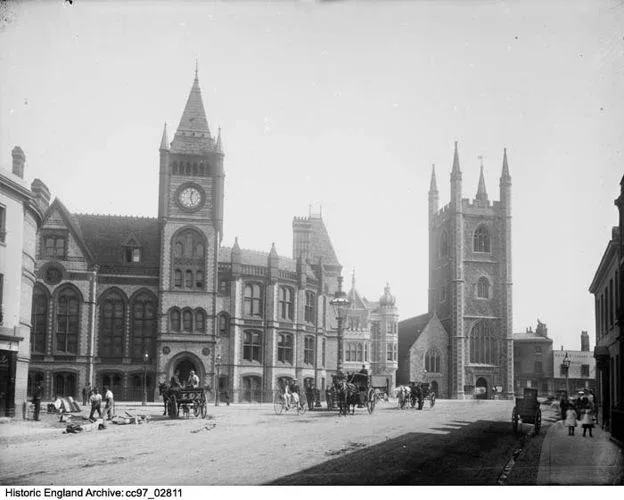
The physical expression of this ambition was the Town Hall on Blagrave Street, built in phases between 1786 and 1897, which served as the headquarters of the borough council until 1976. It is a building that tells the story of Victorian municipal self-confidence in its very fabric: expanded and improved as the council's sense of its own importance grew, its final Victorian phase completed just as Reading was about to achieve its most significant administrative status. The Summer Assizes had been moved from Abingdon to Reading in 1867, and the Privy Council formally recognised Reading as the sole county town of Berkshire in 1869 — a designation that carried both practical and symbolic weight, settling a long-running rivalry between the two towns.
The boroughs summoned to the Model Parliament of 1295 included Reading, which had elected two Members of Parliament continuously from that date. The Redistribution of Seats Act of 1885 reduced this to one, and the constituency thereafter changed hands repeatedly between Conservatives and Liberals before the Labour Party began to make it genuinely competitive. The pre-reform parliamentary history of the borough was often scandalous in the manner common to English rotten boroughs: the electorate was small, the influence of local magnates considerable, and the temptation to bribery endemic. The Great Reform Act of 1832 had somewhat broadened the franchise, and the population of the borough was recorded as fifteen thousand nine hundred and thirty-five in 1831, with three thousand three hundred and seven houses — numbers that give some sense of the concentrated, crowded nature of the pre-Victorian town.
County Borough: The Era of Independence
The Local Government Act of 1888 conferred upon Reading the status of county borough. This was not simply administrative nomenclature; it meant that Reading was deemed large enough to govern itself at county level, becoming entirely independent of the newly formed Berkshire County Council that came into being on the first of April 1889 — itself holding its inaugural meeting at Reading Assizes Court, which had been completed in 1861. Reading's corporation would provide all services for its population: education, highways, public health, and later housing, without reference to the county at all. This independence would last, with significant political consequences, for eighty-five years.
The county borough era was the period in which party politics properly entered Reading's local government. Before the 1890s, councillors had typically stood as independents representing ward interests or professional identities. The emergence of organised Liberal and Conservative caucuses, and eventually the Labour Party's rise after the First World War, transformed the corporation from a body of civic worthies into a genuinely partisan institution. The pattern of control that emerged was broadly Conservative for much of the first half of the twentieth century, with Labour making inroads during periods of national Labour strength — particularly after 1945 — and the Liberals occupying a persistent but rarely decisive third-party role.
The most consequential work of the county borough council in the twentieth century's first decades was housing. Reading's rapid Victorian expansion had left behind a substantial stock of overcrowded and structurally inadequate housing in the older parts of the town, particularly in the area between the Kennet and the commercial centre. The council's responses to this — slum clearance programmes, council house building on the town's expanding edges, the absorption of former agricultural land into residential use — shaped the physical geography of modern Reading as completely as the railway had shaped its Victorian predecessor. The annexation of Caversham from Oxfordshire in 1911 — adding the suburb on the north bank of the Thames to the borough — was perhaps the most politically striking of these expansions, requiring as it did the agreement of a neighbouring county to relinquish territory. Again, a familiar theme for us in 2026.
The political dynamics of the inter-war period were further complicated by the rise of the Labour movement in the town's factories and railways. H & G Simonds, the brewery that had operated since 1785; Huntley and Palmers, the biscuit manufacturers who from 1822 had made Reading's name synonymous with a particular kind of mass-produced consumer food; and Suttons Seeds, established in 1837 — these were the Three Bs (beer, biscuits, and bulbs) that dominated the local economy and generated the organised working-class communities that Labour organisers sought to mobilise. The biscuit factory in particular, at its peak employing thousands, was a defining institution of Reading's social geography — its demolition in 1976 after the factory's closure a year earlier marked the end of something irreplaceable in the town's industrial identity and the move to a more modern, information technology dependent era that we are still inhabiting today.
1974: The End of Independence
The Local Government Act of 1972, introduced by Ted Heath’s Tories, was a profound humiliation for Reading — or at any rate was experienced as one. The reorganisation that came into effect on the first of April 1974 abolished county borough status across England and Wales, abolishing the administrative independence that Reading had exercised since 1889 and placing it, for the first time, under the authority of Berkshire County Council.
This was felt as a demotion. The borough council had campaigned vigorously to have its boundaries enlarged before the reforms took effect — seeking to incorporate Earley, Woodley, Purley on Thames, and other suburban areas that had grown up around the town and were functionally part of it — but the government declined to make any changes. Reading entered the new era within the same boundaries it had held since 1911, now sharing county functions with a tier of government it had not previously had to answer to.
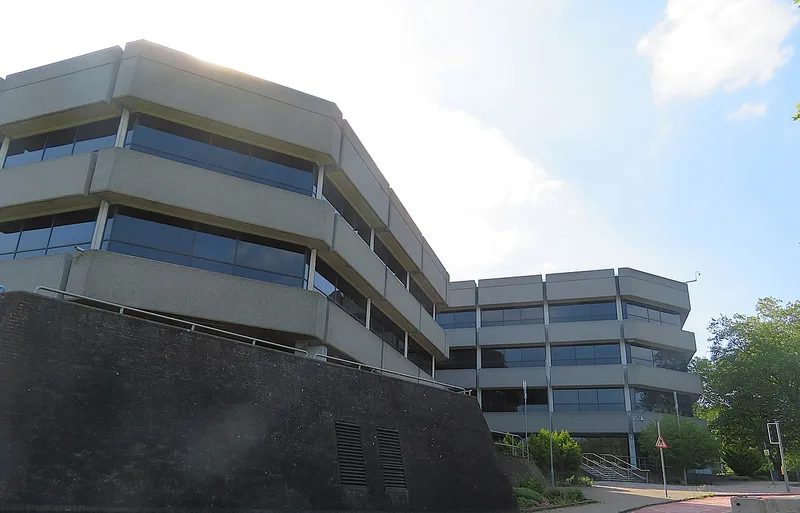
The county council's new headquarters was itself a source of some controversy. Shire Hall, the county's administrative base, was in Reading — but in 1981 it moved to new premises at Shinfield Park on the southern outskirts of the town. Crucially, the new building sat just outside the borough boundaries, in the neighbouring parish of Shinfield. The county council, in other words, had built its new £27.5 million headquarters in one authority's territory while serving another's. This was the kind of jurisdictional absurdity that British local government seems uniquely capable of generating then and now.
The 1974 reforms also introduced the party-political organisation of the county council itself. Before the 1974 reorganisation, candidates for Berkshire County Council had typically stood as independents; party affiliations were not even printed on ballot papers until 1970. The new structure rapidly produced the familiar landscape of party whipping, group discipline, and ideological contest and increasing influence from central government. The Conservatives held a clear majority on the reconstituted county council for the first decade after 1974, with Labour establishing a persistent presence and the Liberal Democrats — particularly in the later years — emerging as a force particularly in suburban and rural areas.
At the district level, Reading Borough Council in the immediate post-1974 period was genuinely three-way marginal. After the addition of parts of parishes from South Oxfordshire in 1977 — the Caversham Park area and parts of Mapledurham — the council stood at twenty-three Conservatives, thirteen Labour, and thirteen Liberals. This was not a comfortable majority for anyone, and political control shifted with some frequency through the late 1970s and early 1980s. The Conservatives held the upper hand for much of this period, but the demographic changes that were reshaping Reading — the decline of traditional manufacturing, the growth of the service economy and the technology sector, increasing diversity in the population — were slowly altering the electoral landscape.
1998: The Restoration of Unitary Status
The abolition of Berkshire County Council in 1998 was a remarkable piece of administrative history. The council had been established in 1889 and it was now to be dissolved just over a century later - its functions distributed among six successor unitary authorities. The process had been fractious. The independent Local Government Commission, convened to consider reform of local government across England, again by the Cobservatives, had in its December 1994 report initially recommended five unitary authorities for Berkshire rather than six; the Environment Secretary John Gummer overrode this recommendation, approving six separate councils in response to local representations emphasising distinct community identities. Berkshire County Council mounted a legal challenge in the High Court, arguing that Gummer's decision exceeded the permissible scope of modifications to the Commission's report. The High Court initially ruled in the council's favour; on the twenty-fourth of January 1996, the Court of Appeal overturned that judgment.
The county council's last day was the thirty-first of March 1998. From the first of April, Reading Borough Council became a unitary authority once again — responsible for all local government functions in the borough, with no county tier above it. This was, in effect, a restoration. The powers Reading had exercised from 1889 to 1974 as a county borough were returned to it, albeit without the boundary expansion that the council had repeatedly sought. The town's built-up area had long since spread well beyond the borough's southern boundary — fixed since 1911 — into West Berkshire and Wokingham, a territorial anomaly that continues to generate friction over planning, transport, and school catchments. Cross-boundary working between Reading and its neighbours is, as one commentator drily notes, "sometimes criticised."
The political impact of the abolition was also significant in a broader sense. Berkshire, unlike most other ceremonial counties, ceased to have any elected body speaking for the whole of it. The six successor authorities operate jointly on specific matters — the Royal Berkshire Fire and Rescue Service, for example, is administered by a joint committee — but there is no Berkshire-wide forum for strategic planning or democratic accountability. The county exists as a ceremonial entity, its name preserved on road signs and in official designations, but without the institutional reality that had underpinned it since 1889.
Labour's Reading: Politics Since 2000
The early years of the twenty-first century brought a period of sustained Labour strength in Reading. The council had been under various forms of control — sometimes Labour, sometimes Conservative, sometimes no overall — through the 1990s, but the 2000s saw Labour consolidate and eventually dominate. By 2012, the council passed into Labour majority control, a position it has maintained without interruption since. This longevity is significant in a town that, at the parliamentary level, remains genuinely competitive: the 2024 general election divided the borough's parliamentary representation between three constituencies — Reading Central, Reading West and Mid Berkshire, and Earley and Woodley — reflecting the complex political geography of a town whose different neighbourhoods have quite different political characters.
The council's recent history has been dominated by the perennial tension of English local government in the austerity era: trying to maintain services under conditions of severely constrained central government funding. Between 2010 and 2019, non-ringfenced government grants to local authorities fell by extraordinary amounts — a reduction in the Revenue Support Grant from nearly £10 billion nationally in 2015-16 to £2.3 billion by 2019-20, representing a direct transfer of fiscal pain from Westminster to town halls. Reading Borough Council, like all English councils, was required to absorb these reductions while meeting rising demand for adult social care, children's services, and housing support.
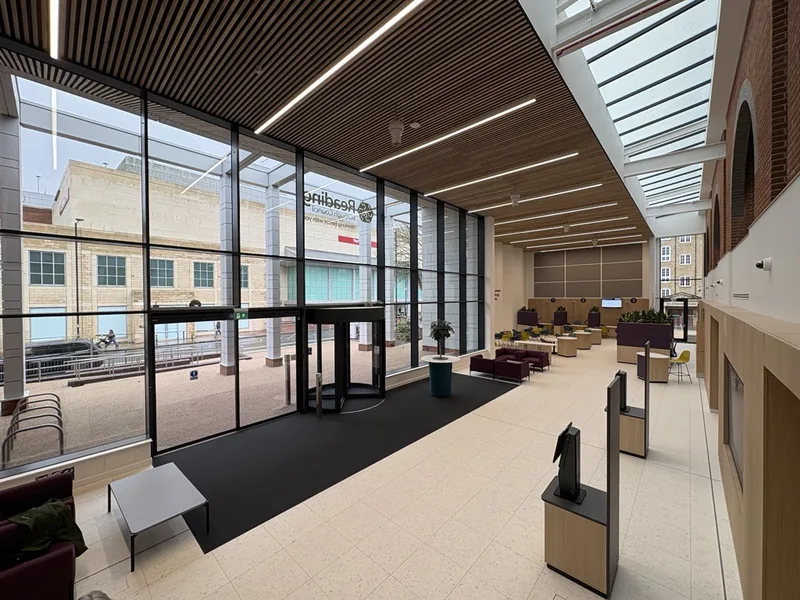
The council moved its headquarters from the Victorian Town Hall on Blagrave Street — which had served as the centre of borough administration since 1786 — to the new Civic Offices on Bridge Street in 2014, a relocation that was both practical and symbolic: a break from the dense civic historicism of the old building towards a more functional, corporate administrative culture. (The Town Hall's annual mayoral meeting remains at the old building, a concession to ceremony if not to daily governance.)
The council leader at the time of writing, Liz Terry, has spoken in terms that illustrate the frustrations of running a Labour authority in an era of constrained central government funding. In a February 2026 budget debate, in response to opposition criticism of rising council tax and service reductions, she contrasted Reading's record with the situations of neighbouring West Berkshire and Windsor and Maidenhead — both of which had, by that point, required Exceptional Financial Support from the government, having declined to raise council tax in earlier years. "I'll make no apology for the hard work we've done to set a balanced budget," she told the chamber, in language that captures the basic tension of modern English local government: the near-impossibility of doing what the law requires without either raising taxes or cutting services, usually both.
However, the election of a Labour government in Westminster has seen reallocation of funding to Reading’s benefit (and Wokingham’s detreiment).
Reading's opposition parties have been equally exercised about the state of the council's finances. Green councillors argued that some of the savings in the 2026 budget represented false economies that would cost more over the medium term. Conservative group leader Raj Singh drew a comparison — gasps from across the chamber suggesting its hyperbole was widely noted — between the Labour administration and Robert Clive. The Liberal Democrats have established a presence in the outlying wards. The political temperature in Reading's council chamber, while not exceptional by national standards, reflects a town in which the old industrial certainties that once grounded Labour's electoral base have been replaced by a more volatile mix of demographic change, economic anxiety, and the politics of housing and planning.
The Boundary Problem and the Shape of Modern Reading
The most persistent structural failure of Reading's local governance is the mismatch between the administrative borough and the actual city. Reading's boundaries to the south of the Thames have not changed since 1911. The urban area has expanded dramatically beyond those boundaries into West Berkshire and Wokingham — suburbs like Earley, Woodley, Tilehurst, and Purley on Thames function as extensions of Reading in every practical sense, sharing its labour markets, transport networks, and social infrastructure, but falling under different local authorities with different political complexions and service priorities.
This boundary problem has been raised repeatedly. Before the 1974 reforms, the borough council sought to expand to include Earley, Woodley, and other areas; the government declined. Before the 1998 unitary reforms, the Local Government Commission recommended expanding Reading's boundaries to include the same communities; the decision was again made to leave them unchanged. The consequence is an urban governance failure of some significance: a town that cannot plan strategically for its own hinterland, whose transport policy must be negotiated across three authority boundaries, whose housing supply is partly determined by councils that prioritise the interests of existing residents in the surrounding areas over the needs of the regional centre.
The proposal for a conurbation between Reading and Basingstoke — dubbed "Readingstoke" by a coalition of opponents who formed CRAG (Readingstoke Action Group, later merged with the CPRE) — was defeated partly through the advocacy of former members of the abolished Berkshire County Council; the terminology may have been fanciful, but the underlying planning pressures were real.
Reading has been represented in every Parliament since 1295. That continuity of representation coexists, somewhat ironically, with a chronic inability to sort out where, precisely, its administrative boundaries should lie, with three MPs and three authorities currently representing the town under different borders, remits and political priorities.
A Town Still Evolving
The unbroken thread of governance in Reading stretching back to an age when its own market stalls were regulated by an abbot who had the King's ear, and its burgesses were beginning, slowly and carefully, to insist that they had something to say about that remain visible in our town, if you know where to look. The Abbey Ward of Reading Borough Council takes its name from the institution whose dissolution created the conditions for democratic borough government in the first place. The Forbury Gardens, where families eat lunch and office workers take their breaks, occupy the ground where Hugh Faringdon was executed for refusing to surrender. The civic offices on Bridge Street sit a short walk from the site of the medieval bridge over the Kennet where, in the winter of 1643, Parliamentarian scouts were halted by floodwaters and could not cross.
It reminds us that history is still being written, so who know what the latest election and local boundary changes will bring to the future story of Reading’s governance ?

Comments
No comments yet. Be the first to share your thoughts.
Join the conversation
Log in to leave a comment on inReading.