
Statues have become one of the most visible battlegrounds in contemporary debates about history, identity, and public space. Once largely ignored—part of the architectural background of daily life—they are now being actively questioned: who they represent, why they were erected, and whether they still reflect the values of the society that surrounds them.
Walk through London and you will find an abundance of figures cast in bronze or carved in stone: mounted generals, imperial administrators, and colonial figures, many of whom are scarcely recognised by the public. Their prominence, elevated on plinths and placed in key civic locations, suggests a hierarchy of importance that feels increasingly disconnected from modern sensibilities. These are not neutral artefacts - they are deliberate statements about power, legacy, and what a nation chooses to celebrate.
The toppling of Edward Colston’s statue in Bristol marked a turning point. What had stood for over a century as an unchallenged monument was suddenly reinterpreted through a contemporary moral lens. The act was not simply vandalism to some, nor purely justice to others—it was a signal that historical narratives are not fixed, and that public symbols can be renegotiated. Similarly, protests in Oxford colleges have highlighted how institutional spaces are also implicated in these debates, raising questions about tradition, benefaction, and moral accountability.
At the heart of the issue is not whether history should be remembered, but how it should be represented. Statues, by their nature, are celebratory. They confer honour. As such, they are a selective version of history—one that often omits complexity, controversy, or harm. In a more pluralistic and self-critical society, there is growing discomfort with uncritical celebration of figures whose legacies are entangled with exploitation or injustice.
This does not necessarily mean erasing the past. Rather, it opens up a broader conversation about rebalancing public memory. Should new statues be erected to reflect a wider range of contributions—scientists, reformers, artists, and those who advanced social progress? Should existing monuments be contextualised, relocated, or retained as historical artefacts rather than objects of reverence?
What is clear is that statues matter. They are not just relics; they are active participants in shaping how we see ourselves and our past. As society evolves, so too must the symbols that occupy its public spaces.
Beyond politics and history, statues are also a vital form of public art. They shape the visual identity of cities, provide focal points in shared spaces, and offer moments of reflection or inspiration in the flow of everyday life. A well-conceived sculpture can humanise a square, commemorate collective experience, or provoke thought in ways that written history cannot. Unlike art in galleries, public statues are encountered by everyone, consciously or not and therefore carry a unique responsibility to engage a broad audience while enriching the cultural fabric of a place. Or they may just walk on by without noticing, on their way to a train, a meeting or the shops.
You therefore might not have noticed that Reading is rich in sculptures. This month inReading is taking a look at our public art and, as the weather improves, encouraging you to take your own look by embarking on a statue trail through our town.
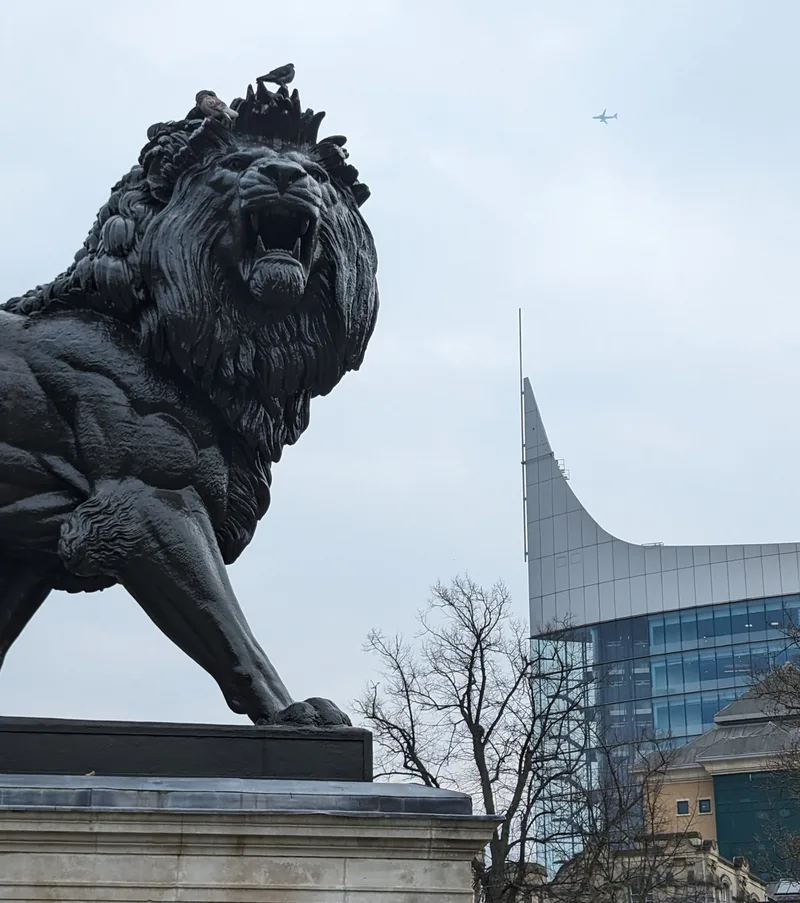
The Maiwand Lion
Perhaps the best known of all Reading’s statues, the Maiwand Lion is the centrepiece of Forbury Gardens, and is one of the world’s largest cast-iron statues. Unveiled in 1886, the monument was commissioned to honour the 328 officers and men of the 66th (Berkshire) Regiment of Foot who died at the Battle of Maiwand and during the wider Second Anglo-Afghan War (1878–1880).
The sculpture was designed by Reading-based artist George Blackall Simonds, a member of the famous local brewing family. Simonds spent two years studying lions at London Zoo to ensure anatomical accuracy before the statue was cast in 11 tons of iron by the H. Young & Co. foundry in Pimlico. Standing at approximately 31 feet from the base to the top of the lion’s head, the figure itself measures 16 feet in length.
A persistent local urban legend suggests that Simonds died by suicide after being told the lion's gait was anatomically incorrect; however, this is demonstrably false. Simonds lived for many years after the unveiling, and he purposely depicted the lion in a "stand-at-bay" posture. Furthermore, a lion’s walk is "pacing" (moving both legs on one side simultaneously), which Simonds correctly captured. The names of the fallen soldiers are inscribed on bronze plaques around the plinth, which was significantly restored in 2024 to preserve the masonry and metalwork.
Of course, Reading has its statues commemorating historical figures.

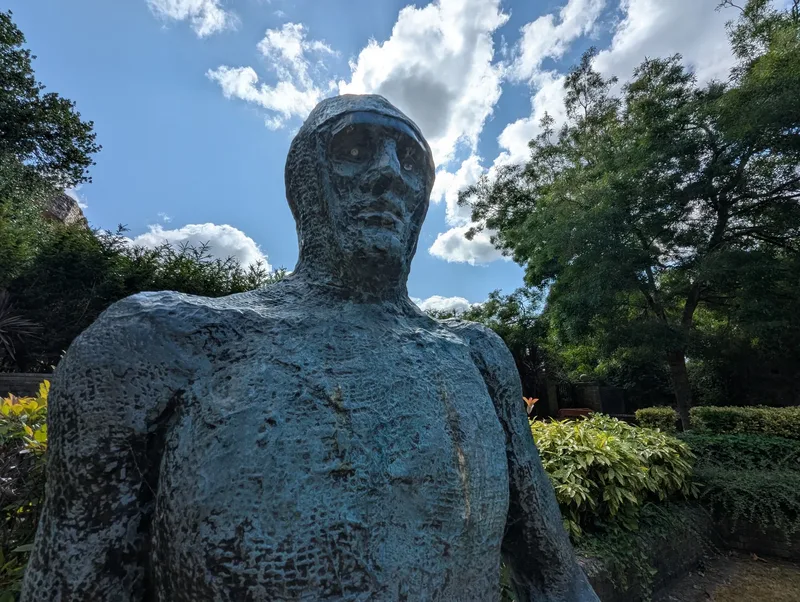
The Executioner
The Executioner (also known as the Robed Figure) is a bronze work by the renowned British artist Dame Elisabeth Frink, installed in the old Abbey quadrangle in 1988. Positioned within the sunken garden of Abbot’s Walk, the sculpture stands in the shadow of the Reading Abbey ruins and the perimeter of the former Reading Gaol. This piece is a cast of the central figure from Frink’s 1986 Dorset Martyrs memorial in Dorchester. While the original group included those being led to their deaths, the Reading installation features only the lone, monumental figure of the executioner, draped in heavy, anonymous robes that evoke an atmosphere of solemnity and judgment.
The placement of the sculpture is deeply symbolic given its proximity to the site where Abbot Hugh Faringdon, the last Abbot of Reading, was executed for high treason in 1539 following the Dissolution of the Monasteries. The figure’s imposing, static presence serves as a personification of state-sanctioned punishment and the impersonal nature of death, reflecting the grim history of the nearby Victorian prison. Unlike more dynamic contemporary works in the town, The Executioner acts as a quiet, sombre site for reflection, bridging the gap between the medieval martyrdom of the Abbey’s past and the modern heritage of the Abbey Quarter.
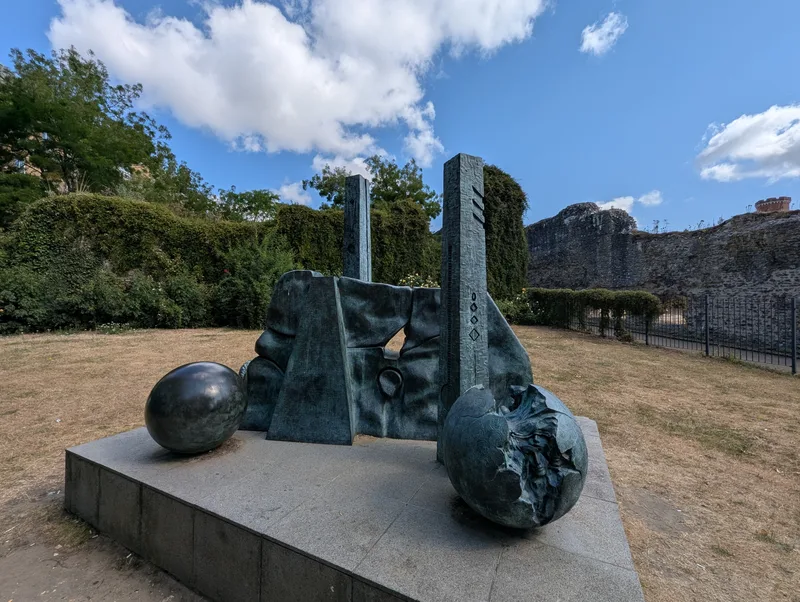
Interpretation of Ruins
Adjacent to the historic ruins of Reading Abbey at the junction of Abbey Square and Abbey Street, the abstract bronze sculpture by Danish artist Jens-Flemming Sørensen provides a modern artistic dialogue with the town's medieval past. Installed in 2000 on a raised green mound, the work is often referred to as an Interpretation of Ruins, though it remains officially untitled. The sculpture features smooth, polished spherical forms emerging from or resting upon rugged, fractured blocks of bronze, mimicking the weathered flint and mortar of the neighbouring Reading Abbey walls.
This juxtaposition of refined geometry and raw, decaying textures reflects the process of architectural erosion and the passage of time. By placing a contemporary abstract piece so close to the physical remains of the 12th-century monastery, Sørensen encourages viewers to perceive the ruins not merely as static historical debris, but as a living part of the urban landscape. The sculpture serves as a visual bridge in the Abbey Quarter, mirroring the organic shapes of the ancient stonework while maintaining a distinctively modern aesthetic.

Oscar Wilde Memorial
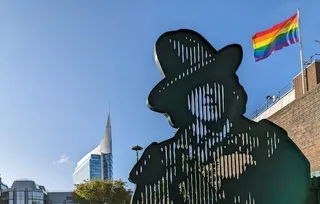
The Oscar Wilde Memorial, a set of gates designed by artist Bruce Williams and unveiled in 2000, is located on Chestnut Walk. The installation is strategically positioned adjacent to the perimeter wall of Reading Gaol, the correctional facility where Wilde was incarcerated for "gross indecency" between 1895 and 1897.
The work consists of a series of double-sided integrated panels and gates made of stainless steel and glass. Williams used a photo-etching process to display images of Wilde alongside excerpts from his final poem, The Ballad of Reading Gaol, and his long letter, De Profundis, both of which were inspired by his time in the prison. The memorial was commissioned to mark the centenary of Wilde’s death and serves as a permanent historical marker of his connection to the town.
Simeon Obelisk
The Simeon Obelisk, designed by sculptor Robert Spiller, is a prominent Portland stone monument located at the junction of Friar Street and Station Road in Reading. Commissioned in 1804 by Edward Simeon, a Director of the Bank of England and brother to Reading’s then-MP John Simeon, the obelisk was originally intended to serve as a functional decorative landmark.
The structure features a triangular base supporting a tall, tapered shaft, which originally housed gas lamps on its three sides—marking it as one of the earliest examples of public gas lighting in the town. Although the lamps were later removed and replaced with decorative carvings, the monument remains in its original location. It serves as a historical marker of 19th-century civic philanthropy and the Simeon family's influence on the urban development of Reading during the Georgian era.
Guardian of the Gate of Sparta
Sculpted by Eric Stanford, was unveiled in 1995 to commemorate the fifth anniversary of the South Street Arts Centre in Reading. The piece is situated outside the centre's entrance and was carved from Portland stone salvaged from the demolition of the old Knightsbridge Barracks in London.
The sculpture depicts a stylized, helmeted warrior figure, referencing the ancient Spartan themes of protection and endurance. Stanford, who served as the Keeper of Art at Reading Museum for many years, designed the work to reflect the Arts Centre’s role as a "stronghold" for the local creative community. The use of reclaimed military stone provides a material link between the site's history and its modern function as a public cultural space.
Requiem
Sculpted by Eric Stanford, was erected in 1990 to commemorate the residents of Reading who volunteered for the International Brigades during the Spanish Civil War (1936–1939). The monument is carved from Portland stone and is situated on Dusseldorf Way, positioned outside the Reading Borough Council's Civic Offices.
The sculpture features a stylised, grieving figure draped in heavy robes, designed to evoke a sense of solemnity and loss rather than a celebration of military combat. It was commissioned by the Reading Spanish Civil War Memorial Committee to honour the local individuals who fought against fascism, as well as those who provided humanitarian aid to Spanish refugees. The choice of material and its central civic location ensure it serves as a permanent public reminder of the town’s historical commitment to international solidarity.
Crystal Beacon
Positioned above a public viewing gallery over the multi-storey car part on the south side of the Kennet at The Oracle, this was designed by John Gingell as part of Hammerson (the developer of the Oracle)'s desire to build contemporary art into the actual fabric of the architecture in 1999. The Oracle used to be a Victorian warehouse.
Made of translucent crystal, the work stands as a beacon for the Oracle and by night it can be illuminated by a state of the art computerised light programme.
Somewhat ironically, it is best seen by car from the IDR flyover beside the Oracle car park.
Girl and The Swan
Installed against a brick wall of Arundell House in King's Road in 1984, Girl and The Swan by Lorne McKean is a bronze depicting a young girl reaching up to touch a swan flying overhead.

The Compleat Angler
Chocolate Island was where the massive Huntley & Palmer biscuit factory stored its chocolate – presumably to prevent pilfering from staff. The pubs further down the Kennet had names like the Jolly Angler and the Fisherman’s Cottage, highlighting the popularity of fishing as a working class pastime on the town’s canal and rivers. The model for this work by Kevin Atherton was keen angler and retired postman, Keith Cooper, who was aged 71 when the work was unveiled 24th November 1992.
Angels
Located outside the west end of St Laurence Church on either side of the main door. The two angels are attributed to James Marshall. They are made of roman cement and were installed in 1806.
‘George’
This statue was sculpted by William Bloye, F.R.B.S., high on the front wall of what was then known as Reading Technical College on King's Road. As Birmingham's unofficial civic sculptor Bloye worked on virtually all public commissions including libraries, hospitals and the University. He often carved bas-relief plaques, typically for public houses in Birmingham and one of his most famed works is the statue of 'Pan' at Aston Hall in Birmingham.
George Palmer
The bronze statue of George Palmer, of Huntley & Palmer fame stands in Palmer Park. The statue, by George Blackall Simonds, was unveiled on 4 November 1891, though it was originally in Broad Street and only later moved to Palmer Park. The statue was moved in 1930 to its current location in its namesake park and has been classed Grade II Listed monument since 14 December 1978.

Unveiling of the statue in Board Street on 4 November 1891
The statue was given by the towns-folk of Reading, "in recognition of his services and gifts to the town", and unveiled 4 November 1891, the same day of the opening of the 49 acre Palmer Park.[7] Four thousand subscribed to the cost of the statue. The opening of the park and the unveiling of the statue have been described as "the biggest celebration Reading had ever seen.
The Gateway
Created by sculptor Clare Bigger in 2000, is a large-scale stainless steel installation located at the entrance of the Reading International Business Park. Standing at approximately 6 meters high, the sculpture was commissioned to serve as a focal point for the corporate development near the M4 motorway.
Consistent with Bigger's signature style, which focuses on the mechanics of movement and athleticism, the piece depicts two dynamic, stylized figures that arch toward one another to form a symbolic archway or "gateway." The structure is composed of brushed stainless steel ribbons that allow wind and light to pass through, emphasizing a sense of lightness and fluidity despite its significant physical scale. It serves as both a navigational landmark and a representation of the modern, kinetic energy associated with the business park.
The Hexham Road Tree
Created by artist Bhajan Hunjan in 1998, is a site-specific floor mosaic located at the entrance of the Hexham Road Community Centre in Reading. The work was commissioned as part of a wider regeneration project for the estate to create a welcoming and culturally inclusive landmark for the local neighbourhood.
The piece features a central tree motif executed in colourful inlaid tiles and brickwork, symbolizing growth, community roots, and the diversity of the area's residents. Hunjan, known for her focus on patterns and geometry, integrated the design directly into the paving to ensure the art remains a functional part of the public walkway. The "tree" serves as a metaphorical gathering point, reflecting the building's role as a hub for social and educational activities.
Harrison Memorial
Erected 1887 and made of Portland stone the memorial is in St Mary's churchyard adjacent to St Mary Butts. The architect was Spencer Slingsby Stallwood. It records the many benefactions of Isaac Harrinson who spent a lot of his money clearing the slums in Reading and particularly those in St Mary Butts. He died a few years after the memorial was erected.
Richard Valpy
Within the exterior niche of St Laurence’s Church, overlooking Reading’s historic Town Hall Square, stands a commemorative statue of Richard Valpy by the sculptor Samuel Nixon. Valpy was a prominent educationalist and the long-serving headmaster of Reading School from 1781 to 1830, credited with transforming the institution into one of the leading schools in the country during the 19th century.
The statue, carved in a traditional neoclassical style, depicts Valpy in his academic robes, holding a book to signify his scholarly contributions and his influential work as a classicist. Its placement at St Laurence’s is historically significant, as the church served as the primary place of worship for the school’s staff and pupils for centuries. As a public monument, it honours Valpy's fifty-year tenure and his lasting impact on the intellectual and civic life of Reading.
Cartwheeling Boys
The Cartwheeling Boys is a distinctive aluminium sculpture by artist Brian Slack, cast at the Brunel University Department of Metallurgy. It was erected in 1981 to commemorate the 30th anniversary of the twinning between Reading and Düsseldorf. The piece depicts three figures in various stages of a cartwheel, a traditional symbol of joy in Düsseldorf that dates back to a 17th-century legend involving a loose carriage wheel. Originally located on a wall at San Francisco Libre Walk near the old Civic Centre, the sculpture was famously toppled by Storm Eunice in 2022. Following a period of restoration using modern computer modelling and traditional casting, it was reinstalled in February 2026 on the façade of the new Civic Offices at the corner of Bridge Street and Fobney Street.
Laying the Reading Abbey Foundation
A Corshill stone panel on the facade of the Old Town Hall, commemorating Henry I who was the founder of Reading Abbey and who was buried before the high altar there. It is located on the frieze between the main doors to the Museum and Old Town Hall and was installed in 1888 after the building was opened in 1882.
The architect was Thomas Lainson and the sculptor Charles Pinker. The scene depicts Henry laying the foundation stone for Reading Abbey.
Reading Piece
The sculpture located outside the former Visa International HQ was commissioned by the company who previously occupied this building, Heron Corporation in 1982. Created by the artist Peter Sainty, the piece is a large-scale abstract work fashioned from welded steel.
The sculpture's design is characterized by its sharp, geometric lines and industrial aesthetic, reflecting the modern architectural style of the business park developments emerging in Reading during the early 1980s. Sainty, an artist known for his structural and minimalist approach, intended the work to complement the corporate environment while providing a bold visual anchor for the site's entrance. The use of steel mirrors the technological and forward-thinking nature of the companies housed within the complex at the time of its installation.
1st Marquess of Reading
The statue of 1st Marquess of Reading (Rufus Isaacs 1860-1935) by Charles Sargeant Jagger is located in the King George V Memorial Gardens, Eldon Square and was moved to its current location in 1971 having been repatriated to Reading in 1961 from Delhi, where it was originally erected. Isaacs was the Viceroy and Governor General of India from 1921 to 1925.
Statue of Queen Victoria
Standing outside Reading Town Hall, this statue commemorates Queen Victoria's Golden Jubilee in 1887. Also sculpted by George Blackall Simonds, it reflects the town's respect and admiration for the monarch.
Statue of King Edward VII
Located in Station Square, this statue pays tribute to King Edward VII, who reigned from 1901 to 1910. It serves as a reminder of the monarch's influence during a transformative period in British history.
The Trooper Potts VC Memorial
Located outside the Reading Crown Court near the entrance to Forbury Gardens, this is a bronze statue group by sculptor Tom Murphy. Unveiled on October 4, 2015, the monument commemorates Frederick Owen Potts, Reading’s only recipient of the Victoria Cross, and his comrade Arthur Andrews.
The sculpture depicts a life-sized scene from the Battle of Scimitar Hill during the 1915 Gallipoli Campaign. After both men were wounded by machine-gun fire, Potts refused to abandon Andrews, who was unable to walk. Over a period of 48 hours, while under constant enemy fire and suffering from dehydration, Potts used a discarded entrenching shovel as a makeshift sledge to drag Andrews over 600 yards to the safety of the British lines. This feat earned Potts the nickname "The Hero with the Shovel."
The memorial was commissioned by the Trooper Potts VC Memorial Trust and serves a dual purpose. In addition to honouring Potts and Andrews, the plinth features a Roll of Honour listing the names of 426 men from the Berkshire Yeomanry who lost their lives in the Boer War and the two World Wars. The project was officially unveiled by the Lord Lieutenant of Berkshire and television presenter Chris Tarrant to mark the centenary of the act of bravery.
Historically, some have felt that the University of Reading shared a similar lack of prominent public monuments. However, this is a narrative currently being rewritten. The University has recently launched a major Public Art Strategy, including a £200,000 endowment for new commissions. Works like the "Floating Garden" by Ben Cain and Tina Gverović and the upcoming "Missing Yew"—an eco-sculpture designed by Petre Nikoloski to fuse living trees with stone—signal a shift toward art that is living, communal, and contemporary.
The Royal Berkshire Hospital also has sculptures . It houses a significant permanent art installation titled "The Gift of Life", which was unveiled in 2015. Located in the main entrance reception area, the piece is a large-scale wall installation designed by the Hospital Art Studio to serve as a memorial to organ and tissue donors.
The artwork consists of hundreds of 3D butterflies that span an entire wall, arranged in a way that their collective silhouette forms the shape of a large heart. The butterflies were chosen as a symbol of transformation and "rebirth," and the five specific species depicted are all indigenous to the Berkshire Downs. To create a sense of movement, some of the smaller butterflies are applied directly to the wall surface, while the larger ones are mounted on spacers to appear as if they are fluttering into the room.

Tucked away in the tranquil Englefield Garden deep within the hospital is a sculpture known as "The Diver" stands as a striking example of contemporary kinetic art. Created by the renowned sculptor Sophie Dickens—the great-great-granddaughter of novelist Charles Dickens—the piece was installed in 2018 as the centrepiece of a therapeutic sanctuary dedicated to the memory of Sir William Benyon (1930–2014), a former Member of Parliament and a significant benefactor to the hospital.
The work is a multi-part bronze installation that captures a single male figure in the various stages of a high dive or somersault. Rather than a static, singular statue, Dickens used five distinct figures to create a "stop-motion" effect, leading the eye in a fluid, circular arc toward the surface of the garden's pond. The sculpture is celebrated for its raw, muscular energy; the figures are constructed from individual wooden blocks that were later cast in bronze, giving the work a textured, skeletal appearance that emphasizes the mechanics of the human body in motion.
The placement of "The Diver" within the Sir William Benyon Memorial Garden was a deliberate choice by the garden’s designer, Jennifer Benyon. Designed to provide a "haven of peace" for patients, staff, and grieving families, the garden uses the sculpture’s dynamic energy to contrast with the stillness of the water. In a clinical environment, the diver’s bold plunge serves as a powerful metaphor for courage, the transition between states of being, and the restorative power of movement.
The deployment of statues in Reading continues. The multi-billion pound Station Hill development, acting as a new gateway between Reading Station and the town centre, features a £1.5 million public art trail unveiled between 2024 and 2025. These works were curated by Futurecity to reflect Reading’s industrial, botanical, and social history through a modern, high-tech lens.
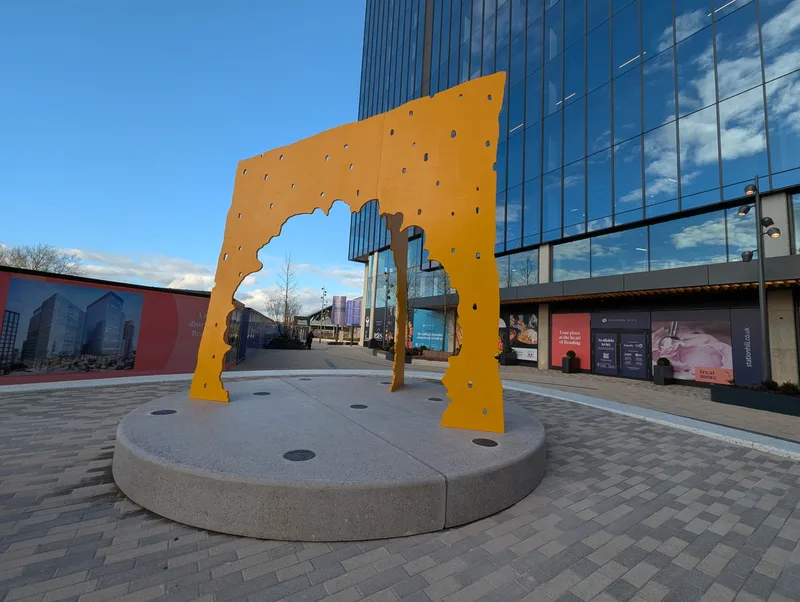
Seed
Designed by Rachael Champion and Jonathan Trayte, Seed is a five-metre-tall sculpture located in the central piazza. It features a vibrant orange silhouette of a pot marigold (Calendula officinalis) seed, a direct tribute to the horticultural legacy of Suttons Seeds, which was once headquartered in Reading. The sculpture sits on a cylindrical terrazzo plinth made from recycled brick and glass, embedded with nine bronze reliefs. These reliefs depict magnified seed textures captured via scanning electron microscopy at the Natural History Museum, selected in collaboration with the University of Reading's herbarium.
PIVOTAL
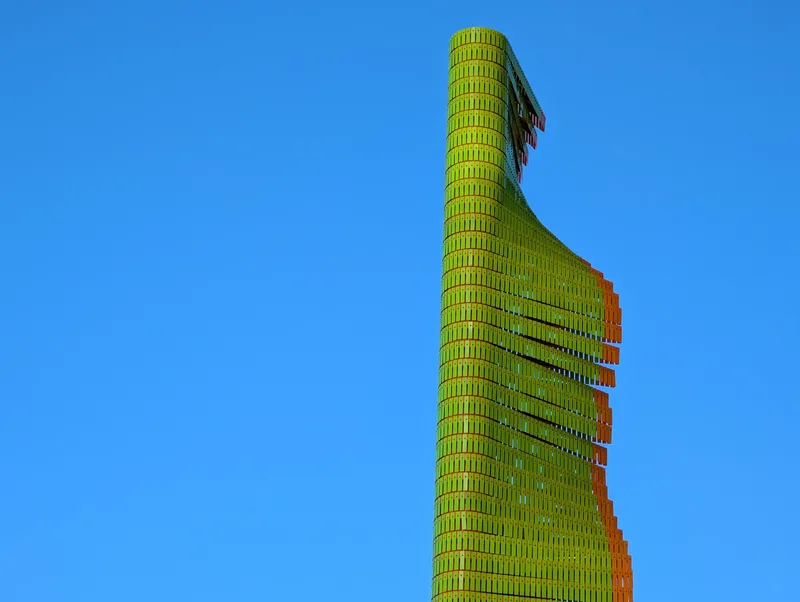
Standing 14 metres high outside the ONE Station Hill office building, PIVOTAL is a kinetic sculpture by the design studio NEON (Mark Nixon and Viliina Koivisto). It consists of 73 vertical fins that rotate independently in the wind, mimicking the movement of a flag or a shifting skyline. At night, the installation is transformed by an internal LED system that cycles through animated light sequences, making it a permanent landmark for the 20 million passengers who pass through the station annually.
The Station Hill Murals
Two massive, backlit murals created by artist Kev Munday and sculptor Stuart Melrose anchor the pedestrian routes. These pieces combine a distinctive "pop-art" illustrative style with advanced material science, using laser-cut aluminium and HIMACS solid surface panels.
Royals, Residents & a Rock Festival: Located near the station underpass, this 51-metre-long mural features a "who’s who" of Reading, including Kate Winslet, Ricky Gervais, and Marianne Faithfull, alongside landmarks like the Hexagon Theatre.
Rivers, Ruins & Regency: Positioned at the Friars Walk end of the development, this piece focuses on historical figures such as King Henry I and Mary Russell Mitford, alongside references to Huntley & Palmers and the Abbey.
Both murals are programmed with thousands of LEDs that change colour and "wink" at passersby, with the lighting sequences updated throughout the year to mark local festivals and milestones.

Comments
No comments yet. Be the first to share your thoughts.
Join the conversation
Log in to leave a comment on inReading.