
Reading Borough Council is moving on its transport policy and not everyone is happy. In fact, almost no one is. What is going on and will it help the dire traffic problems in our town ?
If there is one subject that riles almost all of us who live in Reading, it is that of transport.
There are two fundamental issues. A town dissected by a railway and two rivers, restricting north - south movement, and the inheritance of an American style approach to town planning from the sixties and seventies that favoured the car above all else.
So, news that a new long term transport plan is being discussed by our recently elected councillors has resulted in worried cries from many local citizens, however they travel, and seeming dissent amongst our representatives.
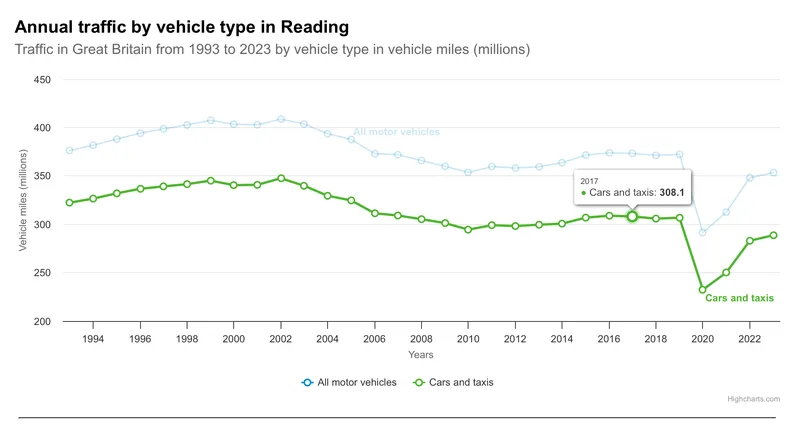
This week, RBC announced that 17.5 million bus journeys were made last year in the town, which was 1.5 million more journeys than the council had expected, and 13 million train journeys were made - three million more than expected. But the council was hoping for 150,000 park-and-ride journeys, but only 106,000 journeys were actually made. 350 million miles were travelled on Reding roads according to the Department for Transport, continuing a declining trend.
That's a lot of moving about after the rather sedintary years of 2020 and 2021, things are getting back to normal, although Mondays and Fridays seem somewhat quieter than before...
You can find out more about what the Council has in store for us by reading the Transport Policy here https://www.reading.gov.uk/vehicles-roads-and-transport/transport-strategy/reading-transport-strategy-2040/
If you cannot be asked to wade through pages of rhetoric with few firm ideas but lots of sweeping statements and generalisations, the summary (in their words) is:
Our vision is to deliver a sustainable transport system in Reading. This will create an attractive, green and vibrant town which promotes healthy choices and wellbeing.
Future mobility options will enable everyone in Reading to thrive, enjoy an exceptional quality of life and adapt to meet new challenges and opportunities.
We have worked with local businesses, community groups and Reading University to create our vision.
Transport will be critical to enhancing the networks needed to help create sustainable economic growth. It will enable everyone to enjoy the multitude of assets the town has to offer. This will be key to low carbon living, and creating a green and healthy spaces to allow our communities to thrive.
There are five objectives which underpin our vision:
· Creating a Clean and Green Reading - Provide transport options to enhance a quality of life, reduce emissions and improve air quality to create a carbon neutral town.
· Supporting Healthy Lifestyles - Create healthy streets to encourage active travel and lifestyles, improve accessibility to key destinations and increase personal safety.
· Enabling Sustainable and Inclusive Growth - Enable sustainable growth and connect communities so that everyone can benefit from Reading’s success.
· Connecting People and Places - Promote the use of sustainable modes of transport by providing attractive alternatives to the private car, helping to provide a transport network that is fast, affordable, connected and resilient.
· Embracing Smart Solutions - Use technology to manage the network efficiently and allow informed travel choices, whilst enabling Reading to become a smart connected town of the future.
In a consultation last year the majority of local people who responded were in favour of the draft proposals, which emphasise cycling and public transport, with the aim of reducing the air pollution in the town. But what does all of this rhetoric actually mean ?
Fundamentally, it seems to be proposing implementing more bus and cycle lanes at the expense of motorists (even local or no emission motorists).
Pressing issues such as the burgeoning use of eScooters and eBikes which are a frequent subject to debate amongst us residents, seem to have so far been marginalised.
Already, the anti-car policies can be seen in the planning of new developments, which are being built with little or no provision for parking. The recently completed development at Huntley Wharf and Thames Quarter have barely any parking spaces (and no EV recharge points, as far as this writer is aware).
The fundamental challenge facing our representatives is turning a town that was built for the motor car into a town that eschews private vehicles in favour of other forms of transport. The problem is that the Council cannot go back to the sixties and rework the landscape of the town as this objective really demands.
Buses are already so busy, and until recently, largely very polluting, that there have been arguments to bring back trams or trolleybuses, along the no 17 bus route, for example. Reading ran a tram network from what is now part of The Oracle from 1901 to 1939.
So, how did we get here ? It all started when the bright eyed burghers of Reading, led by the influential Harry Tee, decided that much of the town was to be demolished and replaced with an inner ring road. The Inner Distribution Road (IDR) opened in 1969 as a radical solution to the regular traffic buildup in the town center, but its construction led to the demolition of several central Reading neighbourhoods, significantly altering the town’s landscape, and cut off most suburbs from the centre of town (see the video below).
Little attention was given to pedestrians and even less to cyclists - then an antiquated form of transport suitable for developing nations only, not relevant in leading metropolises like Reading (oh, how things have changed).
Cycling
To this day, cyclists in Reading seem to use pavements and paths far more than they use the roads, perhaps understandably so. For example, the route of the ‘National Cycleway 422’ through Reading looks like a literal crash course in how not to implement a thoroughfare through a busy urban area. But this poses dangers for pedestrians - there was a bike-on-walker fatality at the top of Wokingham Road in recent years.
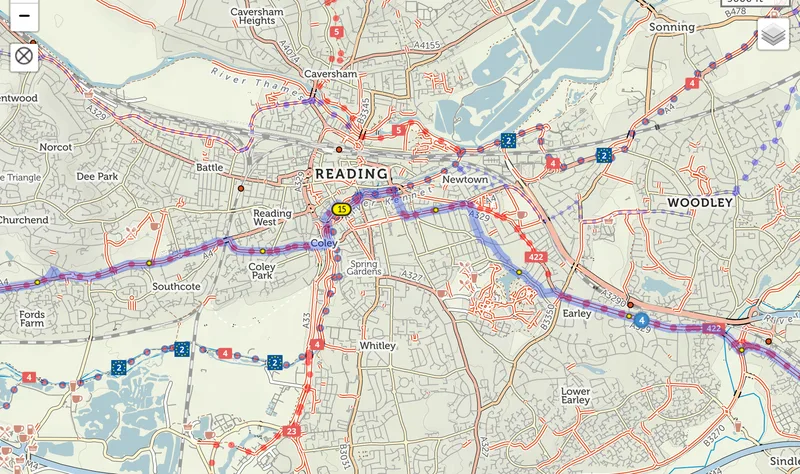
Now eBikes and electric scooter riders are adding to numbers and the dangers to walkers on pavements and paths are apparent, it has become a hot topic for many locals. Central Reading resident Ryan Shook is amongst many pedestrians who disdain of the rise in unregulated semi-motorised vehicles:
“I see far too many riders of legal, registered motor scooters driving on pavements, creating risks for pedestrians. In Reading town centre I regularly see riders drive over the pavement near Sainsbury's on Friar street in order to avoid a bus gate restriction during certain periods. Further along Friar Street near Nandos the motor scooters drive on the pavement to park at a pedestrian crossing and drive down the pavement to the side of Nandos in order to collect from the delivery window. Too many times I have had motor scooters drive towards me as I'm walking down the pavement.
"I'm also completely dismayed by the lawlessness of all sorts of illegal e-bikes - those that are not registered, exceed the allowed power output, use a throttle instead of pedal assist and are not speed limited. Of particular concern are the purpose built e-motorbikes that I see coming in and out of Kenavon Drive that I assume to be part of the illegal drug trade. Additionally many of the delivery riders have no lights, are almost invisible at night, ignore all sorts of traffic signals and expect pedestrians on the pavement to get out of their way.”
There is little doubt that something needs to be done to make cycling (and scootering) safer, but the piecemeal implementation to date has been slapdash and poor. Take the remote and desolate cycle lane in Sidmouth Street, which has exacerbated traffic jams around East Reading, often resulting in near gridlock and significantly adding to pollution and frustration.
Achieving safe, shared streets should be central to the local transport policy, but does not seem to be a consideration.
On The Buses
The one bright spot in our transport infrastructure has to be Reading Buses. Reading has a young population and the cost of driving is prohibitive thanks largely to insurance fees, so buses provide a lifeline for large parts of our population. Indeed, our town has one of the lowest car ownership rates in the UK. Reading Buses provides regular and comprehensive services during the day and has almost become a victim of its own success, with buses full and roads sometimes clogged with a long line of buses.
Where there are four lanes, giving two of them over to buses (and taxis) makes sense, but where there are only three lanes, this becomes much more problematic and can slow down all traffic. So, the proposal to establish a bus lane on the bottleneck between Cemetery Junction and the Suttons Seeds roundabout on the A(M) 329 seems to make little sense, even if it does for the rest of London Road.
Not So Green
The rhetoric from the council’s strategy document is very much focused on green issues above all else, so it seems strange that many recent decisions fly in the face of this.
The scourge of fast food drive through restaurants in places such as Forbury Road and Oxford Road cause traffic tailbacks and congestion, resulting in pollution and road safety issues (let alone other health and ecological impacts). Central government planning policies are blamed.
The proposal to add a bus lane on London Road between Cemetery Junction and Suttons Seeds Roundabout is vehemently opposed by the local Green Party, who you would think have thought about these things in the round.
The Sidmouth Street one way system has clearly created much more ecological damage than it has solved. The council disputes this.
There seems to be little encouragement for EVs and more climate friendly modes of motor transport. The speed at which Reading Buses has replaced its very noisy and highly polluting vehicles has been glacial.
Where is the ecological benefit in all of this ? A lot of rhetoric and then bad ideas, badly implemented seems to be what locals see and a waste of £27m of central government funding, issued by Boris Johnson's government, on piecemeal and unimaginative ideas proposed, it seems, by the unimaginative transport officers in our council. Perhaps they should consult experts at the University and make inventive use of AI, which is deal for addressing complex travel problems rather than blindly following old, tired ideas.
Isolated
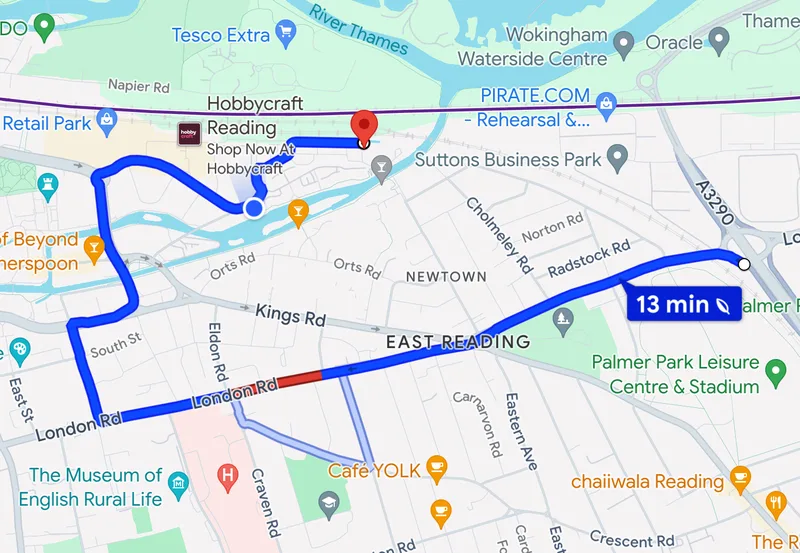
There are areas of Reading that are particularly affected by these issues and decisions. The journey from the M329 to Robert Parker Road near the old gas holder - a distance of a few hundred yards as the crow flies, can take up to forty minutes by car or public transport, made worse by the local closure of Gas Works Road and the one way system around Sidmouth Street.
Endless Road Works
And roads need to be repaired and improved - potholes seem to be a pet local peeve - but the chaos this causes seems endless. One or more lanes of the reasonably new A33 seems to be constantly closed for works, resulting in traffic tailbacks for cars and buses alike. Walkways to the Thames have equally been bedeviled, closed for much of lockdown, when a means of providing access could easily have been provided if the council had pressed the contractors (and done some due diligence so that they did not go bust).
Caversham seems to be particularly badly hit, with the combination of bridges, narrow roads and one broadband provider after another digging up the highways resulting in total mayhem and justified complaints from local traders and residents.
Road Safety
Thankfully, road safety seems to have become less of an issue, probably since Reading’s roads have become safer, despite eScooters and eBikes. The Kings Road area around Reading College – which has two bus lanes – seems to be the most dangerous places in town.
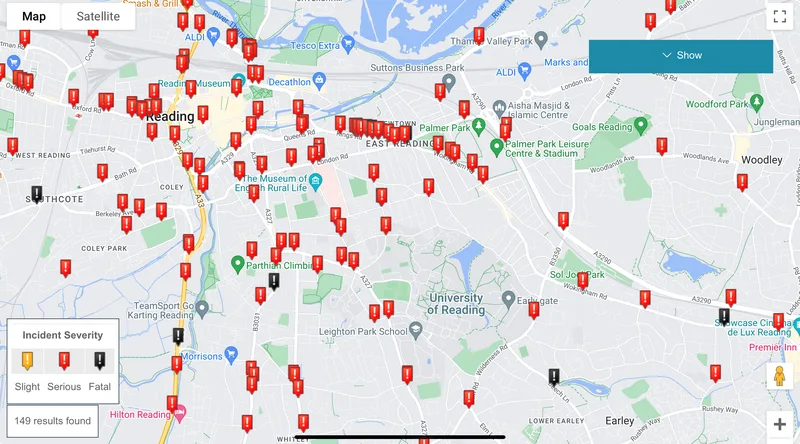
Serious and fatal accidents in Reading 2019-2022
Provisional figures from the Department for Transport show that there were 285 road casualties in Reading in 2023 – a 19% fall from 351 the year before and also a decrease from 431 in 2014, which saw the most injuries in the last 10 years.
Our policy makers have a tough job on their hands, rolling back the serious mistakes of the past and anticipating changing trends. The difference between the IDR on a Wednesday in term time and a Friday in the school holidays is telling, and perhaps their decision making should be led by data, not knee jerk, piecemeal sticky plasters. Perhaps better use of data and science and AI and not piecemeal decisions could result in better outcomes.
But one thing is for sure, if you own a car in Reading, things are going to get worse, not better. And if you are a pedestrian, there is no one defending your rights.

Comments
No comments yet. Be the first to share your thoughts.
Join the conversation
Log in to leave a comment on inReading.