
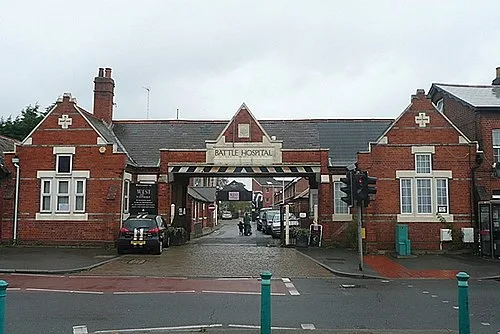
While the Royal Berkshire Hospital on London Road often claims the spotlight, for generations of West Reading residents, the true heart of local healthcare was Battle Hospital. Situated on the Oxford Road, Battle was a site of grit, transition, and survival—evolving from a Victorian place of last resort into a frontline military hub and, eventually, a bustling general hospital before its final closure in 2005.
From Workhouse to Ward
The origins of Battle Hospital were far humbler than the grand Bath stone of the "Royal." Opened in 1867 as the Reading Union Workhouse, it was initially a grim Victorian institution designed for the "destitute and infirm." At the time, healthcare was an adjunct to poverty relief; the site included a chapel, a bakery, and a laundry, operating as a self-contained village for those with nowhere else to go.
Despite the name and the hospital’s significant military history during the World Wars, the title "Battle Hospital" was not a tribute to any specific military engagement. Instead, the origin is much more geographical and local.
The Geography of "Battle"
The hospital was named after the Battle Ward, the local municipal district in West Reading where it was located. This ward, in turn, takes its name from Battle Farm, which once occupied much of the land in that area of the town.
The "Battle" nomenclature stretches back even further to the medieval era. The land was originally owned by Battle Abbey in Sussex. Following the Norman Conquest in 1066, William the Conqueror granted significant holdings in the Reading area to the monks of Battle Abbey as a means of providing them with an income. This historic link to the Sussex abbey (itself named after the Battle of Hastings) became permanently etched into the local map of Reading.
While the site had been a workhouse and an infirmary for decades, the name was officially changed to Battle Hospital in 1930. This change was a deliberate attempt by the Reading Borough Council to remove the stigma attached to its previous incarnation.
It is a striking historical irony that a hospital named after a Sussex abbey and a local farm ended up playing such a vital frontline role in the medical "battles" of two World Wars.
The "No. 1" War Hospital
The site’s identity was forever altered by the outbreak of the First World War. In 1914, it was requisitioned by the War Office and designated as the Reading No. 1 War Hospital. This was an important moment in Reading's war history; the town became one of the most significant hubs for the Royal Army Medical Corps (RAMC) in the country.
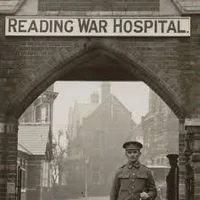
The scale was immense. Battle served as the "hub" for a network of 5 section hospitals and 38 auxiliary sites. Between 1914 and 1920, thousands of soldiers arrived by train at the nearby West Reading station, their stretchers carried through the gates to be treated for war wounds, trench foot, gas inhalation, and shrapnel wounds. It was during this era that the hospital shed its "workhouse" stigma and became one of the war’s largest medical establishments.
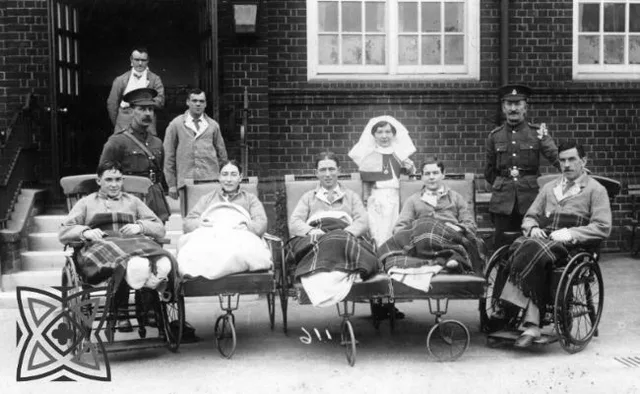
The interwar years at the Oxford Road site—the period between the demobilization of the "Reading No. 1 War Hospital" in 1920 and the birth of the NHS in 1948—represented a complex era of transition. It was during this time that the facility evolved from a military casualty hub into a permanent, civilian municipal hospital, finally shedding the grim reputation of the Victorian workhouse.
The Post-War Handover
When the military vacated the site in early 1920, the complex was handed back to the Reading Board of Guardians. However, the town had changed. The war had proven that the site was capable of far more than just housing the "destitute." In a significant move in 1921, the institution was renamed the Reading Battle Infirmary.
While it technically remained under the administration of the Poor Law, the 1920s saw a shift toward professionalization. The infirmary began to operate more like a general hospital, accepting acute cases that the Royal Berkshire Hospital could not accommodate.
The 1929 Local Government Act
The most significant turning point occurred in 1930. Following the Local Government Act of 1929, the Board of Guardians was abolished, and control of the infirmary passed to the Reading Borough Council. This was a landmark moment: for the first time, the hospital was a true municipal asset, funded by the local authority rather than charity or the "workhouse" levy.
It was at this point, in 1930, that the site was officially renamed Battle Hospital. Under the council's leadership, the 1930s became a decade of modernization:
· The Maternity Shift: Until this period, many births in Reading occurred at home or in small private nursing homes. Battle began to develop a dedicated maternity wing, establishing its reputation as the town's primary "birthplace"—a legacy that would last until 2005.
· Specialist Services: The hospital began to specialize in infectious diseases and elderly care, areas that the Royal Berkshire Hospital (which focused on surgery and acute trauma) tended to avoid.
The Second World War: The "EMC" Era
As the 1930s drew to a close, Battle Hospital was once again prepared for conflict. In 1939, it became part of the Emergency Medical Service (EMS). This was a government-coordinated scheme to organize hospitals into a national network to deal with expected air-raid casualties.
During the Second World War, Battle served a dual purpose. It remained a civilian hospital for the people of West Reading, but it also became a major center for the treatment of wounded soldiers and, crucially, victims of the Blitz. The hospital’s proximity to the Great Western Railway made it a primary destination for "ambulance trains" arriving from London and, later, from the coast following the D-Day landings in 1944.
The Road to 1948
By the time the war ended in 1945, Battle Hospital was no longer an "infirmary" for the poor; it was a battle-hardened, multi-disciplinary medical center. It had developed robust pathology labs, an X-ray department, and a dedicated nursing school.
When Aneurin Bevan launched the National Health Service on July 5, 1948, Battle was seamlessly integrated. It ceased being a local council responsibility and became part of the new national healthcare system. The "Battle spirit"—forged in the workhouse, tested in two world wars, and refined by municipal pride—became a cornerstone of the Reading healthcare experience for the next half-century.
The NHS Era and the "Battle" Spirit
For the next five decades, it was known for its "no-nonsense" character. While the Royal Berks handled high-profile cases and complex surgeries, Battle was the workhorse of the town, housing the maternity units where thousands of "Dings" were born, as well as specialized elderly care and rehabilitation wards.

Key personalities like Lionel Williams, the former Chief Medical Photographer, have spent decades documenting this era, preserving the memory of the "Florence Nightingales" of West Reading who managed the transition from primitive wartime medicine to the high-tech digital age.
The Final Transition: 2005 and Beyond
By the 1990s, maintaining two separate large-scale hospitals in Reading became strategically difficult. In 1993, the Royal Berkshire and Battle Hospitals NHS Trust was formed to manage their consolidation.
The final chapter for the Oxford Road site began in 2005, when all remaining clinical services were transferred to the expanded London Road site. The closure marked the end of 138 years of medical history on the site. However, the legacy of Battle Hospital lives on in two ways:
The "Battle Block": A major wing at the current Royal Berkshire Hospital was named in its honor, ensuring the name remains part of the local medical vocabulary.
The "West Village": The original site was redeveloped into a vibrant residential community. Most of the old hospital buildings were demolished to make way for hundreds of homes and a large Tesco supermarket, though the original gatehouse remains a silent sentinel to the thousands of lives that passed through its doors.

Comments
No comments yet. Be the first to share your thoughts.
Join the conversation
Log in to leave a comment on inReading.