
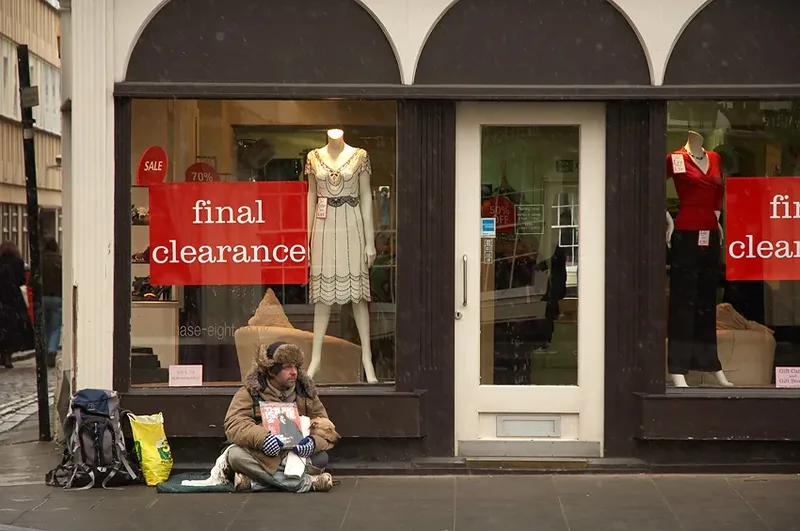
As we approach Christmas, inReading takes a look at the housing crisis affecting our town as, following a Freedom of Information request by Local Democracy Reporter Esmé Kenney, it has emerged that Oxford City Council has moved 34 homeless families to Reading. Oxford remains liable for paying the rent or B&B or hotel accommodation for the moved families, but the burden on social support such as healthcare is moved with the families.
It’s not so much as a tale of two cities, but the tale of how a prosperous city is having to resolve its housing problems in neighbouring authorities in the shadow of regional reforms which may see them in the same extended ‘Thames Valley’ unitary authority.
And this is not just a story about 34 households; it is a symptom of a housing system so gridlocked that "out-of-area placements"—once the shameful last resort of London boroughs—have become the standard operating procedure for many of England’s provincial cities and its effects are now being seen in our town.
Oxford is, by many metrics, a broken housing market. It is frequently cited as the "least affordable place to live in the UK" relative to wages, with median house prices stretching to over ten times the average salary. The city is hemmed in by a Green Belt that has choked expansion, while the relentless demand from the university sector and the booming biotech industry continues to drive rents skyward as more and more land is used for academic and industry uses. The fact that its colleges owns much of the land also exacerbates the situation.
Councillor Linda Smith, Oxford’s Cabinet Member for Housing, has described the situation as an "unprecedented rise in homelessness." The council is legally obliged to house those in desperate need, but their own stock is full and accommodation in Oxford is expensive thanks to demand from students and tourists as well as locals. The private rental market, usually the safety valve, has become a closed door due to the freeze in Local Housing Allowance (LHA) rates, which no longer cover the true cost of renting in the city.
Facing a £1.5 million overspend on housing services and a queue of 10 new homeless families presenting every week, Oxford was forced to look outwards. As a result, they have sent 45 families to High Wycombe, two to Slough, and 34 to Reading. Obviously, for the displaced families, this separates them from the communities, schools, GPs, and support networks they are used to.
Reading Borough Council has reacted with palpable frustration. The town is fighting its own battle with homelessness. In the same period that Oxford began moving families in, Reading saw an 18% surge in its own homeless presentations, with 402 local households currently stuck in temporary accommodation.
The friction arises from a quirk of local government finance: when Oxford places a family in a Travelodge or private rental in Reading, Oxford pays the rent, but Reading’s infrastructure bears the load. These families may need places in Reading schools, support from Reading social services, and care from Reading GPs—services already stretched to the breaking point—without a penny of additional funding transferring from Oxford to Reading to cover the difference.
It would be somewhat unfair to paint Oxford as the villain of this piece. They are caught in a systemic trap that is replicating itself across the South East.
The practice of "out-of-area" placements was normalized by London boroughs sending families to Kent and the Home Counties. Now, the ripple effect has moved further out. As London pushes people to Slough, Slough pushes to Reading, and Oxford pushes to High Wycombe.
And the situation is made worse by a number of factors: housing benefits have not kept pace with market rents, making the private rented sector inaccessible to the poor; private landlords are leaving the market thanks to onerous new legislation and, prehaprs the biggest fault of all can be traced back to the Thatcher government and decades of “Right to Buy” without replacement that have left councils with no assets to deploy. The UK does not need hundreds of thousands of houses – it needs hundreds of thousands of social houses.
The Immigrant Myth
Meanwhile, housing has also become an issue championed by the extreme right and their perceived claims that ‘immigrants are taking our houses and benefits’. In Reading, as across the UK, it should be noted that a person is ineligible to join the Housing Register (for social housing) if they are subject to immigration control.
Data from the 2021 National Census data shows that 15% of people living in social housing in England and Wales were born outside the UK. This is marginally lower than the proportion of the total UK population that is foreign-born. Non-UK-born residents are generally less likely than UK-born residents to be homeowners and are most likely to live in the private rented sector, which often involves higher rent and thus greater use of Housing Benefit, which is part of the Universal Credit system and paid for by central government (although distributed in part by local authorities).
Asylum Seekers are not eligible for social housing or benefits: the estimated 700 asylum seekers in Reading are not permitted to work or claim mainstream benefits (like Universal Credit, Housing Benefit, or social housing). Asylum seekers placed in Reading receive accommodation and basic daily living support from the Home Office (central government), not the local council's welfare system. This support is provided at a low, fixed rate (currently around £7.03 per person per day).
Reading's Housing Crisis
This notwithstanding, as an affluent commuter belt town Reading is already grappling with a severe housing and homelessness crisis, driven by a shortage of affordable housing and significant cost pressures. The number of households in temporary accommodation due to homelessness has seen a dramatic increase, rising to 402 households as of the end of March 2025 - an 18% increase from the previous year. Crucially, 74% of these households (299) include children, highlighting the impact on families.
This rise has substantially increased the financial burden on Reading Borough Council, which spent approximately £2.8 million on temporary accommodation in 2023/24 and further competition from neighbouring boroughs for precious housing resources does not help this situation.
The total expenditure on the Housing Revenue Account (HRA), including the total budget for the day-to-day management, maintenance, and operation of the Council's 7,000 social housing properties was £54.1 million, with a further £28.2 million spent on long-term investment in improving and expanding the social housing stock. Around £12.4m in total was spent in 2024/25 on providing new housing amounting to only 57 new units over the period.
Separately, the official rough sleeping count in November 2024 was 57 people, though the Council suggested a figure of 42 from monthly averages might be more representative. Exacerbating the crisis is a chronic shortfall in new affordable home delivery, with the council reportedly falling short of the estimated annual need for new affordable homes, while the total number of council homes has been falling due to 'Right to Buy' sales, despite new building programmes.
The Real Cause
But the real problem is clear when you look at the reluctant of rich property development companies to provide affordable housing. Over and over again, developers have been able to fide behind ‘Financial Viability Assessment’ (FVA) in order to scale back the number of affordable properties included within their developments. The situation is a national scandal and is particularly acute in Reading.
Reading Borough Council sets a clear policy target - Policy H3 requires 30% of the total dwellings on developments of 10 or more homes to be provided as affordable housing and for smaller sites (5–9 dwellings), a financial contribution equivalent to 20% is sought, which is used to fund off-site affordable housing elsewhere in the borough.
However, according to the Council's latest monitoring report for the 2023/24 financial year, only 21% of the 1,021 new homes completed in the borough were designated as affordable. Whereas this is an improvement on the15-17% achieved in the four years prior, it is still below the 30% policy target and the 400-500 home sit represents would actually have covered the shortfall in the borough theoretically.
So, as we watch all these swish new towers go up in our town, remember that the companies benefiting from these massive profits are the ones causing a crisis at ground level.


Comments
No comments yet. Be the first to share your thoughts.
Join the conversation
Log in to leave a comment on inReading.