

The story of Hugh Faringdon, born Hugh Cook, is bound up with an important phase in the history of England that is well known to every schoolchild. It is also inextricably linked to the fate and destruction of Reading Abbey, once one of the most magnificent monasteries in England.
His tenure as abbot spanned a period of turbulence, as the Reformation and Henry VIII’s dissolution of the monasteries reshaped religious life. Faringdon’s life and horrible death reveal much about loyalty, politics, and the brutal shifts of 16th-century England.
Early Life and Rise to the Abbacy
Hugh Cook was a Benedictine monk who, like many abbots of his era, he came from a local family of some standing, originally from Kent. His surname hints at a trade or family occupation, while ‘Faringdon’ was his adopted monastic name, derived from the nearby Berkshire town of the same name where he was born and raised.
Reading Abbey, founded in 1121 by Henry I, was among the wealthiest and most prestigious abbeys in England. By the early 16th century, it was a centre of pilgrimage (especially for its relic of St. James), learning, and local governance.
Cook was educated at the abbey, became a priest in 1511 and rose steadily through its ranks, demonstrating administrative skill as sub-cellarer where he was in charge of the cellars or undercroft of the monastery and of all the supplies coming into the abbey, which was amongst the biggest enterprises in England at the time.
On 19 September 1520, he was elected abbot, succeeding Abbot Thomas Worcester. At his consecration, he adopted the name Hugh Faringdon. He also had significant civil duties at the local Justice of the Peace and served on various local government commissions.
Abbot of Reading: Prestige and Responsibility
As abbot, Hugh Faringdon was both a spiritual and temporal leader. Reading Abbey controlled vast lands across Berkshire and beyond, collected rents, dispensed alms, and held legal authority over its tenants. The abbot sat in the House of Lords as a mitred abbot, a position of considerable influence.
Faringdon maintained the Abbey’s traditional roles: supporting scholarship, hosting royal visitors, and ensuring that monks observed the Benedictine rule. He was also known for his loyalty to the crown, at least in the early years of Henry VIII’s reign. He corresponded with Thomas Cromwell, Henry’s chief minister, and for a time seemed to have secured Reading’s safety during the king’s initial religious reforms.
The Shadow of the Reformation
Henry VIII’s break with Rome, prompted by his desire to annul his marriage to Catherine of Aragon, sent shockwaves through England’s religious houses. The king declared himself Supreme Head of the Church of England in 1534, forcing abbots and bishops to sign the Act of Supremacy. Hugh Faringdon complied, apparently without protest, signing acknowledgements of the king’s authority.
But compliance was not enough to guarantee survival. The monasteries were immensely wealthy, and Henry and Cromwell had their eyes on their lands and treasures, using their religious reforms to dissolve the monasteries and plunder their wealth. The first round of dissolutions targeted smaller houses, but by 1539 the king was determined to suppress the great abbeys as well.
Resistance and Accusation
Hugh Faringdon’s fate was sealed by his position and, eventually, his conscience. Reading Abbey, with its wealth and prestige, could not be ignored. Although Faringdon had outwardly supported the king, he was accused of concealing support for the Catholic cause, particularly in relation to papal authority.
The precise charges against him remain debated to this day. Officially, he was accused of treason for denying the king’s supremacy and allegedly providing aid to rebels during the Pilgrimage of Grace, a northern uprising in 1536–37. Some historians believe the charges were fabricated as a convenient means to seize the abbey’s wealth.
In 1539, Hugh Faringdon was charged with high treason after being accused of giving financial aid to the Northern rebels. He was captured at Bere Court, his manor in Pangbourne, and taken to the Tower of London, where he was imprisoned for two months. Although, as a mitred abbot, he had the right to be tried by Parliament, Thomas Cromwell, the Lord Chancellor, ignored this safeguard. His death sentence was issued before any trial took place. Together with John Rugg, a close associate, and John Eynon, the parish priest of St Giles’ in Reading, Faringdon was declared guilty and executed by hanging, drawing, and quartering outside the Abbey’s inner gatehouse on 14 November 1539.
John Rugg was additionally accused of hiding one of the Abbey’s famous relics, believed to be the hand of St Anastasius. The monks of Reading, who were not implicated in the supposed treason, were granted pensions in line with the usual provisions made for monks and nuns following the dissolution of their monasteries.
Trial and Execution
In November 1539, Hugh Faringdon, together with two of his senior monks, John Rugg (the Prior) and John Eynon (a monk of the abbey), was tried and condemned for treason. The verdict was a foregone conclusion. On 14 November 1539, the three were drawn on hurdles from the Abbey to the scaffold outside the abbey gatehouse, where the modern Forbury Gardens now stand.
There, before a crowd of townspeople and tenants, Hugh Faringdon was hanged, drawn, and quartered — the brutal punishment reserved for traitors. To be hanged, drawn, and quartered meant being publicly humiliated by being dragged to execution (showing the traitor’s loss of honour), hanged and cut down alive (a denial of a clean death), disembowelled and burned (symbolising the destruction of treasonous body and soul), and finally beheaded and quartered (so the traitor could never be whole again, with the parts displayed as a warning to others).
He was about sixty years old. His body parts were displayed, probably some on the Abbey Gate, a grim warning to others. Reading Abbey was officially surrendered to the Crown on the same day.
The Fall of Reading Abbey
After Faringdon’s death, the abbey was stripped of its treasures. Gold and silver plate, books, relics, and vestments were seized. The buildings themselves fell into ruin, plundered for stone over the centuries.
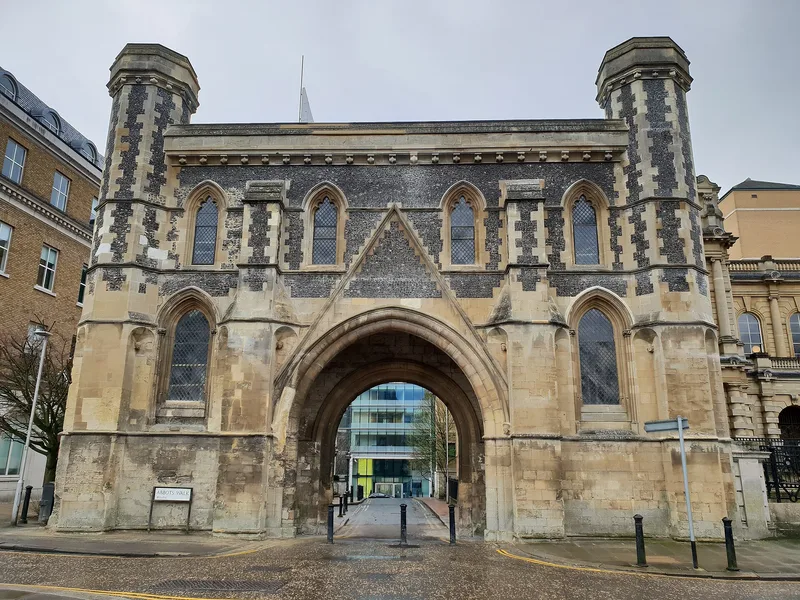
Today, only fragments of the once-great abbey survive in Reading’s Forbury Gardens and surrounding streets, though conservation efforts have restored some of the ruins and you can still see and sometimes visit the gatehouse outside which Faringdon was executed, which subsequently famously became the school attended by Jane Austen.
Legacy and Memory
Hugh Faringdon was remembered by Catholics as a martyr for the faith, one of many abbots executed during the dissolution. In 1895, Pope Leo XIII beatified him, recognising his steadfastness and sacrifice. He is thus Blessed Hugh Faringdon, commemorated on 15 November by the Catholic Church.
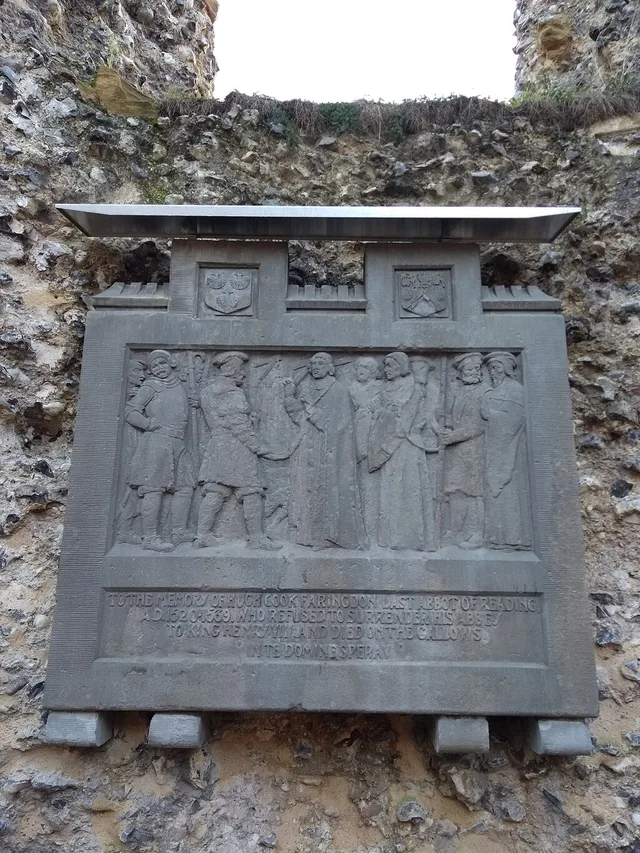
In Reading, his legacy endures. A Catholic secondary school bears his name — Blessed Hugh Faringdon Catholic School in Southcote — and his story is told as part of the Abbey’s history with a plaque commemorting his martyrdom as a stark reminder of the violence of the Reformation and the human cost of Henry VIII’s policies.

Comments
No comments yet. Be the first to share your thoughts.
Join the conversation
Log in to leave a comment on inReading.