
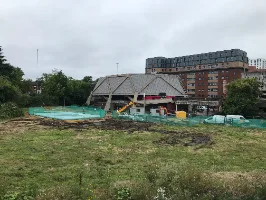
A studio theatre, a new town square, a new library and affordable housing are all on the way in a major town centre regeneration project, but there will be no bigger live event venue for the town.
For nearly 50 years, The Hexagon has been Reading’s favourite six-sided venue. But work is now underway to turn it into something with a bit on the side as part of an ambitious project to create the 'Minster Quarter' where the current police station, civic building, allotment and Hexagon theatre stand.
Few would argue that the area around the popular theatre hasn't been a bit unloved in recent years.
While once the rear exit of the Broad St. Mall was home to an array of shops, an underground pub, a bustling street market and a nightclub, much of that has closed down or moved.
Plans are now underway to redevelop that section of the shopping mall, creating four residential tower blocks that will contain more than 600 flats, of which 80 will be affordable. It comes at a cost to parking spaces: there will be just over 400, compared to the 700+ that are currently available.
Permission was granted in April, and developers McLaren Living say this will be a landmark destination of the town that celebrates its 20th-century heritage, while reinforcing the town’s status as an arts and culture destination.
Announcing the scheme, Oliver Westray, Development Director of McLaren Living, said: “Our approved scheme will regenerate Broad Street Mall and deliver an enhanced and reinvigorated mixed-use neighbourhood, one which will deliver on the council’s plans for the area and align with its vision for the town.”
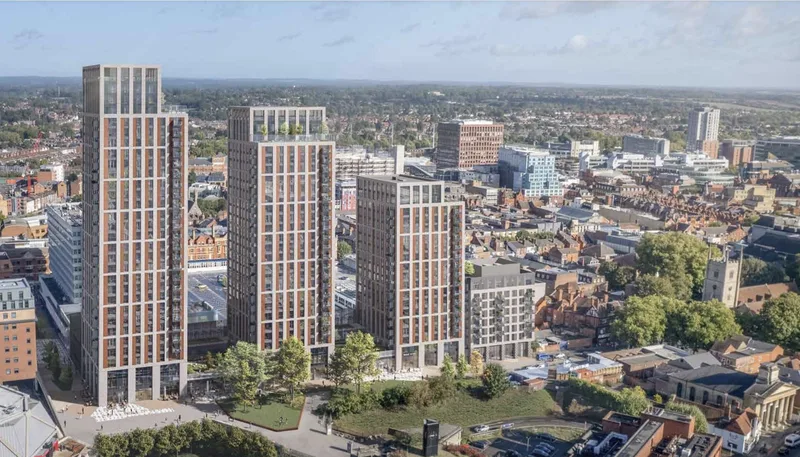
Impression of the completed Broad St Mall housing development
The work on Broad St. Mall is not the only redevelopment taking place. In February 2024, Reading Borough Council unveiled its plans for the new Minster Quarter, complete with the Hexagon Square. It will include 600 apartments, a community hub, a hotel, and an open space – perfect for flashmobs to surprise people with impromptu performances – which is described as a 'gateway' to The Hexagon and its new sibling, the Studio Theatre.
It will connect to Dusseldorf Way which, in turn, leads to Hosier Street and the rear of the Broad St. Mall.
The aim is to create a development that helps the council’s net zero ambitions, and this includes on-site renewable energy generation, dedicated cycle paths, and a net gain in biodiversity.
In all, the Reading Minster Quarter development is 5.2 acres in size and will occupy the space where the former council offices were before it moved to Bridge Street.
And there will be more: over the coming years, there will be additional schemes coming together, including a redevelopment of the Thames Valley Police station. Later this year, the force is intending to move to Atlantic House near to the Select Car Leasing Stadium, a three-storey office block. The force also intends to maintain a town centre base.
When the cop shop opened in the 1980s, it was one of Europe’s largest stations, but it is now deemed too expensive to run. The search for a new base began in 2012, so this has been a long process.
The initial proposals for the replacement building on Castle Street suggest there will be a retail, residential and commercial development. If this design progresses, there will be 260 apartments in a tower block with four smaller blocks.
The Reading Magistrates Court is already moving to a new home in King Street in the former BDO offices opposite the current library.
In all, it is expected that the Reading Minster Quarter will deliver at least 1,200 homes, with some of them affordable and suitable for families to live in.
Announcing the plans for the Minster Quarter two years ago, the then leader of Reading Borough Council, Jason Brock, said: “The regeneration of the Minster Quarter represents an unprecedented opportunity to deliver one of the best located mixed-use development opportunities in the UK, right in the heart of Reading town centre.”
As with Broad St. Mall, McLaren Living has been selected to deliver the scheme.
The company’s managing director, Matthew Biddle, said at the announcement: “Our ambition is to create a new mixed-use neighbourhood which transforms this historic part of the town, bringing new public realm, much-needed new homes, high-quality employment space and enhances The Hexagon Theatre.”
The Hexagon Studio Space
In January 2023, Reading Borough Council announced it was planning to revamp The Hexagon by creating an extension that would house a new studio theatre. It will host a variety of performances, including live music, and provide a focus for a new community to be on established in the Minster Quarter.
Funding comes from grants from the then government’s Levelling Up Fund to revitalise The Hexagon. The £19.1 million will help create The Hexagon Studio Theatre, and improve its older sibling, which first opened in 1977, while also funding work to create a new Central Library as part of the Reading Borough Council offices on Bridge Street.
The proposal extends the right-hand side of the existing building with an entrance directly off Queens Walk, and is the first phase of the Minster Quarter regeneration scheme.
The Studio Theatre’s facilities include a 200-capacity theatre, a rehearsal studio, office space for Reading Arts staff and a new loading bay. A new entrance will be created to ensure step-free access from Queens Walk and link the theatre with the new Hexagon Square. However, some of the plans were recently scaled back due to 'budgetary constraints'.
In November 2024, it was revealed that The Hexagon could be the first theatre in the country to be powered by water heat pumps, as old gas boilers are removed and replaced with the high-tech solution.
Last year, an exploration saw two 120m deep boreholes drilled into the site to see if underground water flows would be warm enough and powerful enough to power The Hexagon’s heating needs. This confirmed that it would be possible, and if it goes ahead, there will also be air source heat pumps installed to ensure they cover any gaps.
Richard Lane, Director, Drift Services Group, which carried out the exploratory work, says: “Our drilling and testing of the boreholes at The Hexagon confirmed the presence of high-quality water in the aquifer, ensuring not only the required flow rates but also the efficient return of water to the aquifer — an essential factor for the system’s performance and the sustainable nature of this clean, green energy solution.”
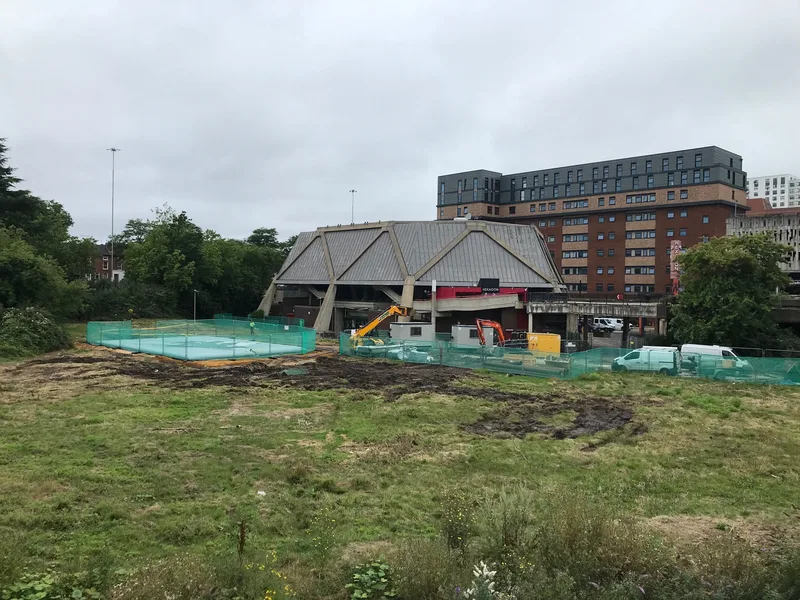
The curtain came down on The Hexagon as we know it on Sunday, July 13. But the show must go on, as they say, during the building period and the venue reopens for its autumn season on Saturday, September 27th, with a performance of The Dinosaur That Pooped: A Rock Show, followed by Taylormania - A Taylor Swift Eras Tour Tribute on Sunday September 28th.
Feltham Construction will have 11 weeks to break the back of the construction works and will use the pause in programming to demolish the existing back of house of The Hexagon, and create a temporary one in Lavender Gardens.
The introduction of the digital set for last year’s pantomime of Cinderella means audiences will still be able to enjoy the festive treat: this year’s show is Beauty and the Beast, and once again stars Justin Fletcher and Paul Morse.
The Studio Space project is due to be complete by the spring of 2027.
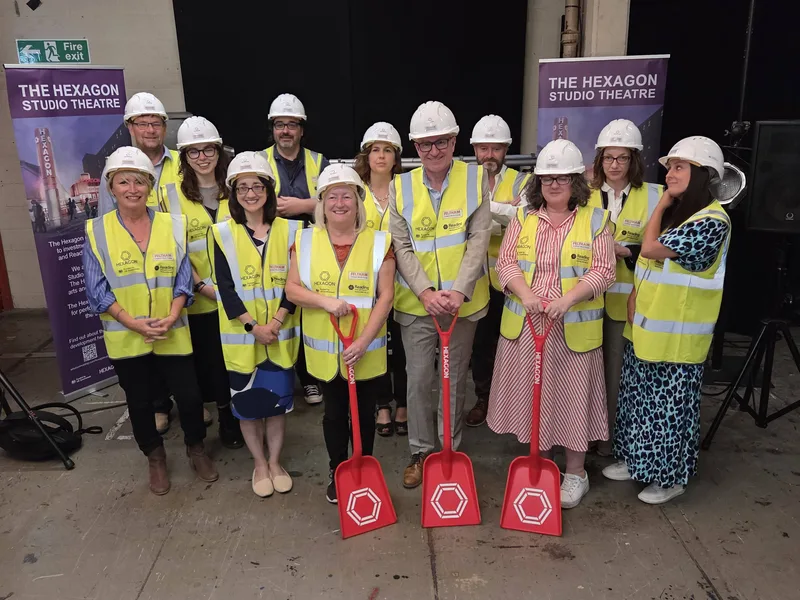
A groundbreaking ceremony was held on Monday, July 14, with speeches from, among others, Reading Borough Council leader Liz Terry, Lead Councillor for Leisure Cllr Adele Barnett-Ward, and chief executive Jackie Yates.
Speaking afterwards, Cllr Barnett-Ward says: “The Studio Theatre is absolutely going to be a huge improvement. We are going to have a campus of theatres; the people who live and work in Reading deserve to have something special, and that is what we are delivering.
“It feels like it has taken us such a long time to get to this point, and it feels like it’s going to be absolutely no time at all before we will be opening the new theatre – less than two years is incredible.
“It is important to note that we are going to be open as usual throughout this time.”
She added that the thinking behind the Studio Theatre was to create something Reading currently lacks: a good, mid-sized live music venue.
“It has been designed to work as a theatre, but you can also clear the seating back and have it as a live, standing music venue with balcony seating for people who would rather sit down.
“We have worked with John Luther, who runs South Street’s programme. He has been involved from day one on this project, making sure we have a studio theatre that can deliver not only the things people love from a smaller theatre, but also the sort of shows he hasn’t been able to host at South Street.
“We will be expanding and building on what we already have.”
In addition to the wider range of shows Reading Arts will be able to offer audiences, the theatres will be more accessible full stop.
“Everyone can currently access the performances, but we could do better. With the Studio Theatre we will have podium-level access (from Queen’s Walk) so whichever show you are going to, you can enter through there; it will be fully wheelchair accessible throughout. It will feel a lot more welcoming to people,” she continues.
With this new venue, some residents have voiced concern about the future of South Street Arts Centre, Reading’s former Labour Exchange turned quirky venue for all kinds of shows including beer festivals, music performances, experimental plays, and live comedy.
However, Cllr Barnett-Ward says: “John Luther, as artistic director of South Street, has been involved in the planning of the Studio Theatre since day one. If John Luther is happy with it, I’m happy with it.”
Among the proposed line-up, Cllr Barnett-Ward says she will look forward to attending a live music performance as a change from the comedy she usually sees at South Street and the big shows at The Hexagon.
“I’m excited about the wider range of shows we will be able to have at The Hexagon,” she promises, adding that this isn’t just about touring shows coming to town.
“There will be a better community space within the Studio Theatre; it has always been the proposal, from the very beginning, that the new space needs to belong to the community.
“People will be able to hire it, they will be able to use it. We have the opportunity to bring in smaller shows, just as we host smaller local theatre companies at South Street.
“This is an opportunity to now get your show right in the centre of town, next to The Hexagon.
“People going to The Hexagon to see a show on the main stage might see you are on in The Studio and look you up next time they come in. It’s going to be brilliant for the visibility of our local arts community.”
So, Reading seems set to add to its surfeit of small venues such as South Street, Reading Rep, Prospect Theatre, The Purple Turtle and Sub89, with many arguing that an opportunity to extend the current Hexagon Theatre and provide a venue that can attract bigger acts beyond cover bands has been missed.

Comments
No comments yet. Be the first to share your thoughts.
Join the conversation
Log in to leave a comment on inReading.