


Amongst the many major developments in central Reading is the long standing scheme to redevelop what is called 'the Bristol and West building'. Many of us pass through it regularly without realising that this was the scene of the bloodiest event in Reading's modern history.
Once home to the eponymous building society, the site that had previously been part of Reading's Corn Exchange, a venue for corn merchants to meet and arrange pricing with local farmers for the sale of wheat, barley, and other corn crops.
Built in the 1850s and located between Market Place, Broad Street and Friar Street, the entrance is still there on Market Place with a frieze inscribed with the words “Corn Exchange.” The tower also housed a clock face and a bell turret with a weather vane. In the 1930s, a modern corn exchange was built adjacent to the Cattle Market in Great Knollys Street, and the old Corn Exchange in the Market Place transitioned into a roller-skating rink. (After falling into disuse in the 1950s, the main hall was demolished in June 1963 to make way for a the current shopping centre that is itself due for demolition under the new plans to build a hotel and appartments.)
During World War II, the building was requisitioned for military use, and it stored 600,000 sandbags. In front of the town hall where the actual Bristol & West building still stands for now was a wartime canteen, the British Restaurant.
Opened in December 1940, this 'People's Pantry' was part of Reading's civil defence network, somewhat ironically designed to provide support and sustenance in the event of air attacks. Staffed by the Women’s Voluntary Service (WVS), it was equipped to seat 100 people and became a place of refuge where hot meals and tea were served. It is often overlooked that the Second World War was a time of considerable poverty as well as deprivation in Britain, so this was the soup kitchen of its day.
Reading had prepared for war, but avoided any real damage during the Blitz and the Battle Of Britain during 1939 and 1940. However, there were 20 air raid warnings over the course of the war, reflecting its position between major strategic targets in London, Bristol and Southampton.
After the Luftwaffe was largely defeated at the end of 1940 the Germans turned to using more indiscriminate attacks from the air, often using single aircraft to avoid providing large scale targets for the dominant RAF fighter planes and the defence radar. They were called ‘nuisance raids’.
It was this that on the afternoon of 10th February 1943 saw a lone wolf Dornier 217-E4 aircraft from the German Luftwaffe's Kampfgeschwader 2 "Holzhammer" based in Soesterberg in the Netherlands come in very low altitude to avoid radar and drop its bombs from just forty meters up onto the Symonds Brewery and what is now The Oracle, and then onto Town Hall Square.

Map showing German targets in Reading, with the town hall earmarked (Source: Berkshire Record Office)

Dornier 217 - E4
At around 4:30pm, air raid sirens wailed, sending residents scrambling for shelter. This time, the threat was real. Four 500Kg bombs were dropped onto the unsuspecting town centre in all and the plane went on to strafe the streets of Lower Caversham with machine gun fire.
One of the bombs struck with devastating precision, ripping through the roof of the People's Pantry, narrowly missing a BBC technician installing an arial on the roof of the building.
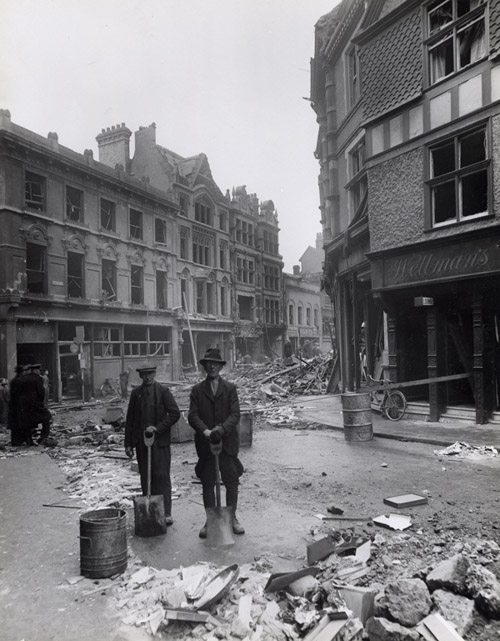
Inside, the café was busy, as the third of the four bombs scored a direct hit, turning the cafeteria into a scene of unimaginable chaos. Twenty-nine people died, including children. A further twelve people were killed by the other bombs and gun fire.The blast's impact rippled outwards, shattering the Town Hall windows and damaging nearby buildings, including St Laurence's Church. Shrapnel rained down, injuring many and leaving the town centre in a state of shock and devastation.
This singular bombing, the only one in Reading to claim lives during the war, had a deep effect on those survirors, one of whom was the young apprentice installing a radio transmitter on the roof of the People's Pantry at the time. His name was Michael Bond.
 Source: Royal Berkshire Archives

Source: Reading Museum
Though shaken by the blast, he miraculously escaped unscathed. This experience, however, would profoundly impact his life, and based from his wartime experiences, including seeing evacuee children on the railways, he would later go on to write the heartwarming stories of Paddington Bear, a refugee seeking solace and kindness in a new and unfamiliar world.
Today, Reading remembers the victims of the People's Pantry bombing with a commemorative plaque near Town Hall Square and the scars of the shrapnel damage can still be seen on the frontage of St Laurence’s church opposite where the People’s Pantry stood and a wreath is laid every year on the anniversary in remembrance of those who perished.

Comments
No comments yet. Be the first to share your thoughts.
Join the conversation
Log in to leave a comment on inReading.