
The timely release of the movie Conclave coincided with the selection of a new pope in Rome. The election of Leo XIV was a seminal event for Reading’s estimated fourteen thousand or so Catholics.
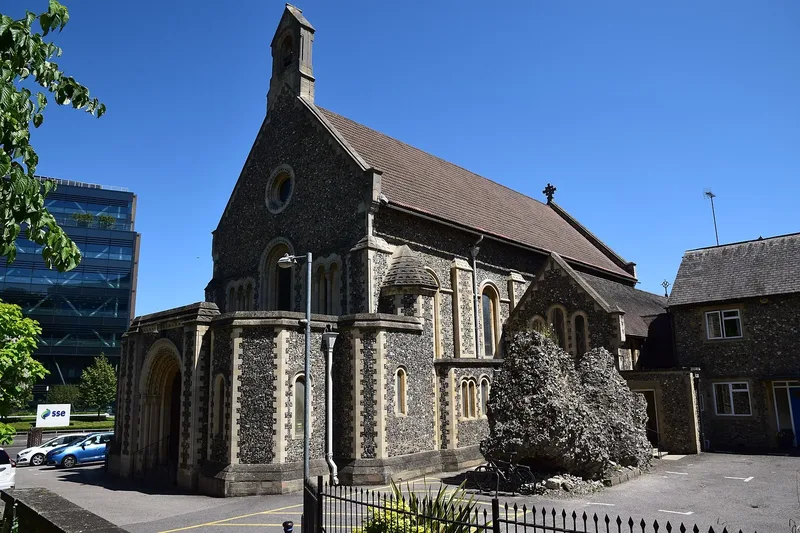
In our current multinational and multifaith town, it’s worth reflecting that in the past nearly all the residents of Reading would have followed the Church of Rome and been Catholics. The ruins of the Abbey ironically sit next to the current main Catholic church of St James as testament to when seismic changes came to undermine the influence of the dominant faith.
In 1121, King Henry I founded Reading Abbey, dedicating it to the Virgin Mary and St James. It wasn't just a church - it rapidly became one of England's wealthiest and most influential monastic centres. Imagine a bustling complex, a powerhouse of prayer, learning, and administration, holding sway over much of the town's life and central to the growth of Reading as a town and commercial centre.
Pilgrims flocked here, drawn by revered relics like the supposed Hand of St James. Royal guests were common, and Henry I himself chose the Abbey as his final resting place – the search for his remains goes on. For 400 years, the Abbot of Reading was a national figure, wielding immense local power and sitting among the lords in Parliament. Reading was the Abbey, and the Abbey was Catholic England in microcosm. By the 16th century, it ranked among the top 10 wealthiest abbeys in England.
The Storm of Reformation
Then came the seismic shifts of the 16th century. King Henry VIII's break with Rome and his Dissolution of the Monasteries hit Reading with brutal force. In 1539, the Abbey's lifeblood was cut off.
Its last Abbot, Hugh Faringdon, stood defiant. Refusing to surrender the Abbey or renounce the Pope's authority, he was declared a traitor. In a grim spectacle designed to quell resistance, he was hanged, drawn, and quartered in the shadow of the very Abbey gates he had defended. This violent act marked the end of public Catholic worship in Reading for centuries. The magnificent Abbey buildings were plundered for stone, falling into the haunting ruins we see today. For the faithful, Catholicism became a religion of secret masses in hidden rooms, reliant on the courage of recusant families and clandestine priests.
After the Dissolution of Reading Abbey in 1539, Catholicism was effectively outlawed in Reading, with harsh Penal Laws making it illegal to attend Mass and dangerous for priests to serve local Catholics. By the late 18th century, there were only about 50 Catholics in our town, though several prominent Catholic families owned large estates nearby like Ufton Court, Mapledurham, and Whiteknights, practicing their faith in secrecy with secret rooms and ‘priest holes’ in case of surveillance from government authorities.
The Faith Returns
Fast forward through nearly 300 years of suppression under the Penal Laws. By the early 19th century, the tide began to turn. The Catholic Relief Act of 1791 marked a turning point, making it legal for Catholics to worship openly. The first Catholic chapel in Reading, the Chapel of the Resurrection, was built in 1811 by Father Longuet, who reported 174 parishioners by 1813. The first Catholic wedding in the town in centuries took place there in June 1813. Gradual Catholic Relief Acts eased restrictions, culminating in the landmark Catholic Emancipation Act of 1829 and open practice was possible again.
In Reading, figures like James Wheble of Woodley Lodge championed the cause. The time was ripe for a visible return. In 1837, work began on St. James' Church, which now sits between the gaol and Forbury Gardens. Its location was deeply symbolic – right beside the ruins of the old Abbey, a poignant link between past and present. Designed by the star architect of the Gothic Revival, A.W.N. Pugin, the church opened in 1840, a declaration that, after centuries, Catholicism was back in Reading. Cardinal Cormac Murphy-O’Connor, former leader of Catholics in the UK as Archbishop of Westminster, was baptised at St James’s Church and served as an altar boy there.
Building a Modern Community
St. James' became the seed from which Reading's modern Catholic community grew. The 19th century saw an influx of Catholics, notably from Ireland, swelling the congregation. Soon, one church wasn't enough.
Throughout the 20th century, as Reading expanded, new parishes sprang up: St. William of York in 1906, followed by English Martyrs, Christ the King, and others serving Tilehurst, Caversham, and Woodley. Catholic schools, like St. James' Primary and Blessed Hugh Faringdon Secondary (named for the martyred Abbot), became vital parts of the community fabric, educating generations. Today, these parishes operate under the Diocese of Portsmouth. The construction of Reading’s Polish Catholic church, St Mary’s, in the late 19th century was marked by tragedy: during the cornerstone ceremony in 1888, a floor collapse injured many and resulted in one fatality.
Reading's Catholic Face Today
Visit a Catholic church in Reading now, and you'll find a community reflecting the town's diversity, with communities from Poland, Goa, the Philippines, Africa, and beyond. Dedicated chaplaincies and Masses in different languages cater to this multicultural tapestry.
From the grandeur of its medieval Abbey to the quiet resilience of the recusant years and the vibrant network of parishes today, Reading's Catholic story is one of remarkable endurance. The echoes of Abbot Faringdon's sacrifice and Pugin's vision can still be felt, woven into the fabric of a modern town where an ancient faith continues to find its voice under the shepherding of a new Pope.
Comments
No comments yet. Be the first to share your thoughts.
Join the conversation
Log in to leave a comment on inReading.